


Templestay

Homecoming Templestay
H
>Templestay
>Homecoming Templestay

A Lone Traveler’s Beautiful Journey
Ms. Jeon’s Templestay in Search of Her True Self
Text by Editorial Staff Photo by Ha Ji-kwon

“Your soul will guide you to encounter your true self again.
Then you will experience the wonder of getting close to a forgotten mystery.”
The mystery of life conveyed by this Celtic proverb is not far away.
Just like guarding a child who may disappear in a flash when you’re not looking,
You should hold the hand of your inner soul, and listen to it face to face.
Ms. Jeon Hyeon-ju’s solitary winter journey to a mountain temple is filled with mystery.

Coincidence or Karmic Connection?
“It was probably in winter about 10 years ago. A friend who had been to Beopjusa’s Templestay told me about this temple. By chance, she witnessed the moment the construction safety fence came down after some extensive repairs were done to Palsangjeon Hall. The beauty of the building left her momentarily paralyzed so that she could not move. Listening to her story, I sometimes imagined what the hall looked like, and now, after a long wait, I am finally here to see it.”
Ms. Jeon Hyeon-ju spoke these words as she was walking along a forest trail carrying a small backpack. Her words revealed a distant memory and the excitement she felt about the destination she would arrive at any minute.
Today she is visiting Beopjusa Temple, an ancient temple with 1,000 plus years of history located in Boeun, North Chungcheong Province. Designated a UNESCO World Heritage site, it is also a jewel that somehow makes Mt. Songnisan more beautiful.
Beopjusa Temple is a truly scenic place where the beauty of nature and tradition is obvious no matter where you look. It naturally draws many visitors, and you can see groups of tourists trodding the forest path to the temple compound.
However, Ms. Jeon’s journey today is a little different from the other tourists. Her pace is not dictated by a hiking companion or the company she works for, so she has time to appreciate the sounds of the forest. This solitary journey is only for herself. Passing a clamorous group of hikers and taking a quieter side path, she pauses momentarily. The gentle murmur of a winter mountain stream caresses her ears to replace the human voices. She resumes walking.
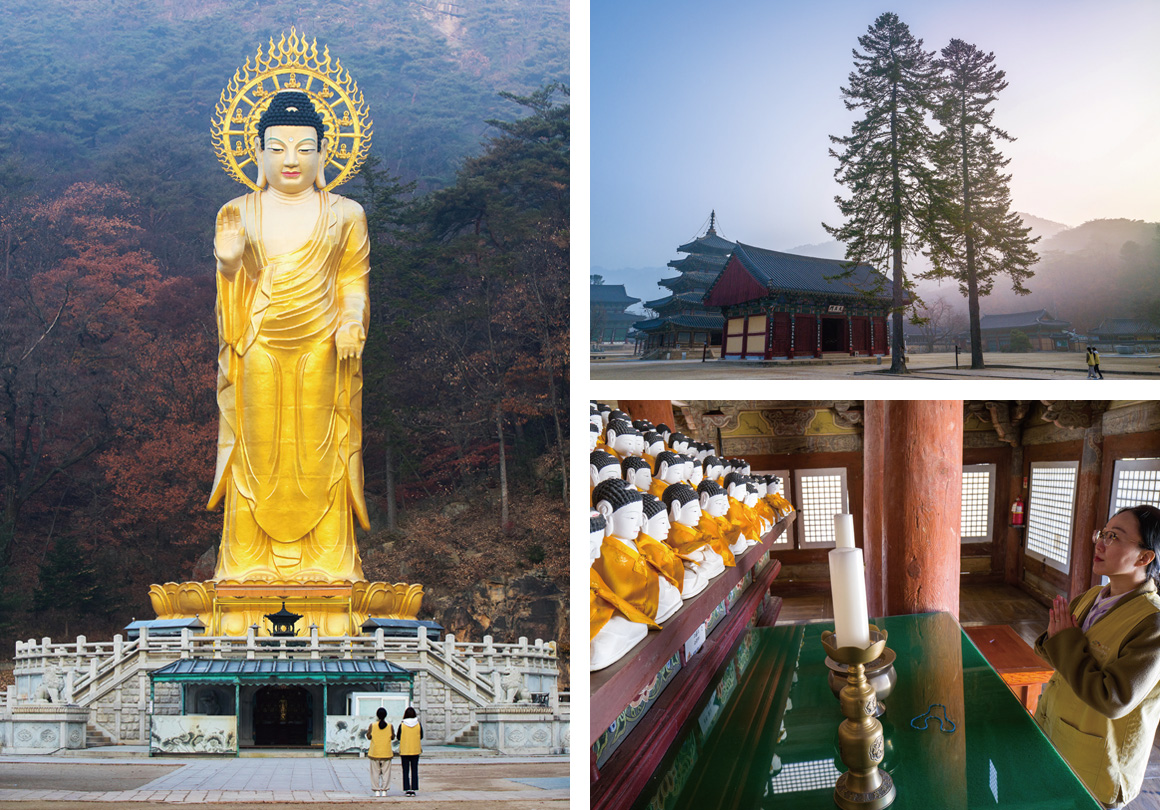
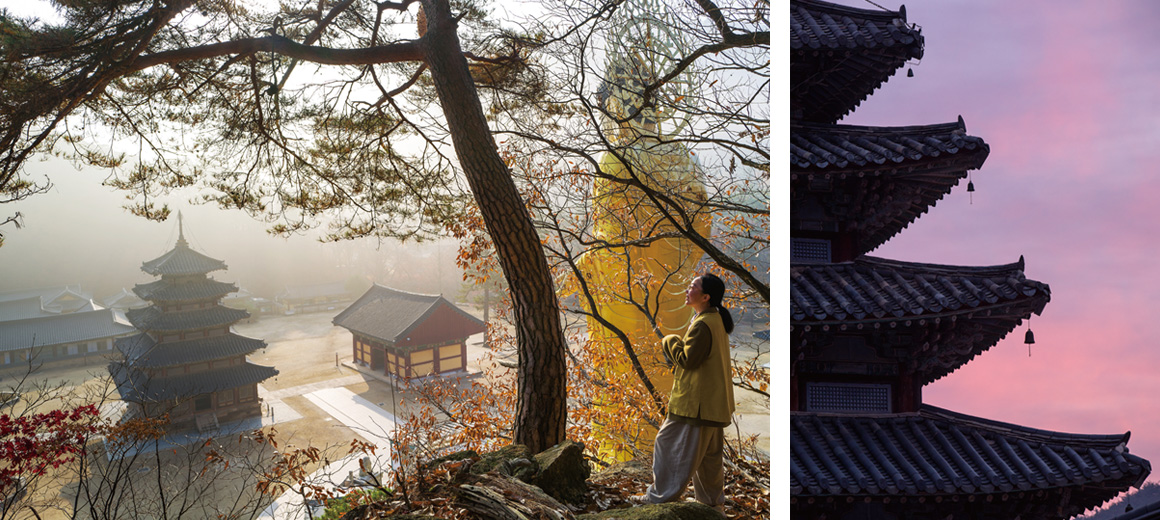
Sejogil Trail is lined with giant pine trees whose ages cannot be guessed. It guides this lone hiker safely to Beopjusa Temples, as if escorting a king. Soon, a solemn stone wall appears to demarcate the secular world and the sacred temple compound. Beyond the wall a great golden buddha statue and Palsangjeon Hall are visible.

At that moment, the beauty of Palsangjeon her friend spoke of long ago becomes a reality.
“Would it sound odd to say I have yearned for this place even though I have never been here before? Nevertheless, I have longed for this moment. It feels like I just met someone I was destined to meet.”
For a while she observes the temple compound over the wall, and then hurries toward the Templestay Experience Center. She had yearned to enter the realm of Beopjusa for so long, but now she was here to enjoy her beautiful journey by herself.
The Most Beautiful Greeting
“Welcome! Thank you for making such a long trip to visit Beopjusa.”
Ms. Lee Sun-nam, leader of Beopjusa’s Templestay team, greets all travelers with a warm welcome. The first order of business at Beopjusa is to check visitors’ temperatures. Staff members diligently check every visitor’s temperature and record them.
Quarantine regulations may be relaxed outside the temple gate, but at this mountain temple (elev. 350m), regulations are strictly observed. There are other temple regulations to be observed besides quarantine. Beopjusa asks even participants of the rest-oriented Templestay program to attend the orientation and temple tour.
“Beopjusa has plenty of officially designated national and general cultural properties. That is why it is often called an open-air museum, blessed by heaven with a wonderful natural environment. You have come from afar, and we feel it is our duty to inform you of the temple’s treasures and the benefits of a Beopjusa Templestay.”
Ms. Lee’s words reflect the staff’s pride in their temple and consideration for their guests. She soon opens the program by explaining the spirit of the Buddhist community in a simple, understandable way.
“Now I will show you the most beautiful way to greet others. Put your palms together in front of you at chest height. This gesture is called hapjang, and it symbolizes the oneness of you and me. Shall we say this together? Namaste! Once again, I welcome you, precious visitors to Beopjusa!”
It was then that Ms. Jeon, who usually tenses up when meeting strangers, greeted the people sitting around her.
It is time to face the self within and the other self which is omnipresent. From the simple greeting “Namaste,” she realizes she is not alone even when she thinks she is.
The Present
Participants begin “a walk with a monk,” a popular activity in Beopjusa’s Templestay programs. Listening to stories about Beopjusa spun by a monk while walking the vast temple compound, steeped in 1,500 years of history, is like drinking from an inexhaustible spring.
Frequented by many kings, from the Goryeo to Joseon eras, Beopjusa housed up to 3,000 monks in its heyday. As a testament to its former prosperity, Beopjusa has an iron caldron weighing 20 tons, and a colossal granite container which can hold 6,400 kg of rice, both perfectly preserved. Other treasures include: Palsangjeon Hall (national treasure), the only remaining wooden 5-story pagoda in Korea; dual-lion stone lantern (national treasure), an iconic Silla era stone lantern; stone lotus basin (national treasure), crafted in the 8th century during the Silla era; and 5m-high rock-carved buddha seated on a chair (treasure). One cannot help but admire these treasures. Soon, sunset envelopes the temple compound, creating a marvelous atmosphere.
The temple tour has ended, but Ms. Jeon continues to stroll around Palsangjeon Hall.
“No matter how long I look at it, I cannot put its architectural beauty into words. A thousand years ago, even before that, someone like me probably stood here admiring this structure. Just looking at it makes me feel like I have been transported back in time.”
If Ms. Jeon encountered ancient aspects of Beopjusa in the temple tour, the singing bowl meditation session led by Ms. Lee, the Templestay team leader, moved her heart in another way.
Singing bowl meditation allows one to become immersed in the waves of sound while sitting in a comfortable position. Ms. Lee, an expert in singing bowl meditation, began to play 7 white crystal singing bowls, and soon, their surprisingly loud and beautiful sounds began to resonate in the participants’ bodies. The sound produced by the bowls purifies body and mind. This was also a way of practice and healing in ancient times.
The 30-minute meditation ended, and Ms. Lee blessed everyone with a bright smile; all the participants smiled back looking refreshed.
Ms. Lee continued: “Would you like to receive my present? It is ‘today.’ You are with us here and now. Try to exist in harmony with all your surroundings, whether seen or unseen, whether heard or unheard. Try to make time for yourself, even for 5 minutes. It is for you, the most precious present brought by today.”
On her way to her room Ms. Jeon reflected on the meditation session, and relayed to me the gratitude in her heart, her face blushing.
“Beyond my closed eyes, a brilliant light shone, moving this way and that. It was such a beautiful moment that even the breathing of someone next to me sounded like music. My solitary journey was rewarded with a great present from I don’t know who.” In the dead of night, behind her brightly smiling face, the moon rose like a crystal.

The Farther You Go, the More You See
At dawn the next day, for a good while Ms. Jeon greets the morning by walking around the temple compound, still enveloped in darkness. As the sun rises and fills the temple compound, Ms. Jeon’s hike to Sujeong Peak on Mt. Songnisan begins.
This hike is special because Sujeong Peak is off limits to the general public; only monastics and Templestay participants are allowed. It is a rocky peak 550m high, and takes about 40 minutes of leisurely walking to get there. It is said that the energy of Mt. Songnisan originates from this peak. Upon arrival, one finds a giant rock in the shape of a turtle. It appears to be lying peacefully in a tranquil forest as if it just descended from heaven. Having hiked to the peak and now panting for breath, Ms. Jeon admires the clouds of fog swirling around Mt. Songnisan, and makes a wish to the turtle-shaped rock.
“When I walked around the temple compound before daybreak today, I was happy, like in a dream. The word ‘alone’ was a perfect description of that moment. While walking around the still dark temple compound, I saw a buddha statue through the half-open
door of a lit buddha hall. In a world of gray, a beam of golden light seemed to radiate from the statue.” She then thought of a small wish she would make after she returned home.
“There was a moment when I felt nothing could possibly change.
But when that moment passed, I was able to feel small changes in light, sound, and even in my breathing. I realized that to see changes arise from what is still and static is a great joy. In the new year, I want to not be so easily exhausted from the mundane repetition of daily life, but find joy in the moment.”
After descending the mountain, Ms. Jeon walked again alone to the Beopjusa Temple compound and Sejogil Trail in the pine forest.
The farther you go, the more you see. This was a precious time to converse with her inner self. I applaud her journey, which is more fruitful because it is a solitary one.

Beopjusa Templestay in North Chungcheong Province
Located in Boeun, North Chungcheong Province, Beopjusa is an ancient temple with over 1,000 years of history. Nestled on Mt. Songnisan, the temple is known for its picturesque mountain terrain, blessed by heaven, its great cultural heritage, and its rich history.
Sejogil Trail follows the path King Sejo walked 600 years ago. It is a gorgeous forest trail surrounded by a variety of trees. It is even more refreshing as it is near Beopjusa Valley. All the roads around Beopjusa are well paved or smoothed, from the Songnisan Public Parking Lot to the temple compound so even the old and infirm can get around easily.
Some popular activities at Beopjusa’s Templestay include: a 90-minute temple tour guided by Ven. Hyeu, director of the Neungin Cultural Center; singing bowl meditation (only on weekends); and hiking to Sujeong Peak (available only to Templestay participants).
The temple tour is received with great enthusiasm by even those who don’t know much about Korea. This is due to Ven. Hyeu’s vast knowledge of history and his charming conversational skill. Singing bowl meditation on Sujeong Peak is another great healing program that has been repeatedly praised by participants. In addition, there are “sound meditation with four Buddhist instruments” and the practice of 108 prostrations, which participants must sign up for in advance.
Beopjusa Temple in Boeun
405, Beopjusa-ro, Songnisan-myeon, Boeungun, Chungcheongbuk-do, Republic of Korea
+82 43-544-5656
www.beopjusa.org



4th Fl. Templestay Information Center 56 Ujeongguk-ro, Jongno-gu, Seoul, South Korea (03145)
Tel : 82-2-2031-2000 / Fax : 82-2-732-9928
Copyright ⓒ 2020 Templestay webzine. All Rights Reserved.
4th Fl. Templestay Information Center 56 Ujeongguk-ro, Jongno-gu, Seoul, South Korea (03145)
Tel : 82-2-2031-2000 / Fax : 82-2-732-9928
Copyright ⓒ 2020 Templestay webzine. All Rights Reserved.