


Buddhism Culture

Buddhist Culture Reflected in Sacred Treasures
H
>Buddhism Culture
>Buddhist Culture Reflected in Sacred Treasures
Enshrine the Buddha in the Rock
Rock-Carved Buddha
Text by. Noh Seung-dae Photo by. Ha Ji-kwon
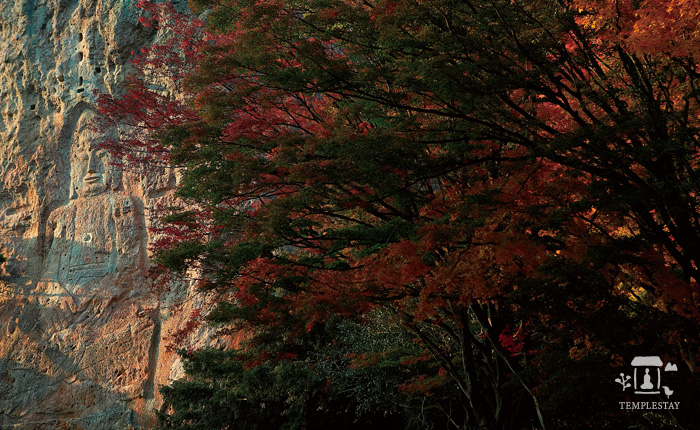
A Long and Distant Journey
In 475 CE, King Jangsu of Goguryeo led 30,000 soldiers to attack Hanseong, the capital of Baekje. After Hanseong was in ruins, Baekje quickly moved its capital to Ungjin (present-day Gongju), and when its state power had recovered to some extent, it moved its capital to Sabi (present-day Buyeo), beginning the last Sabi period of Baekje (538―660).
Due to its geographical location, Baekje interacted with rulers in the Shandong region of China across the West Sea, but when access to the Han River basin was taken away by Goguryeo, ports for travel and trade with China had to be moved to Dangjin and Taean. The Shandong region was ruled by the Eastern Jin (317–420), which introduced Buddhism to Baekje.
It was later ruled by the Northern Wei (386–534), the Eastern Wei (534–550), and the Northern Qi (550–577). Baekje continued to interact with these rulers in order to keep Goguryeo in check.
The stone cave temples and rock-carved buddhas that had originated in India were introduced to China via the Western Regions, and several grotto temples were built in succession, including the Dunhuang Grottoes, Maijishan Grottoes, Yungang Grottoes, Longmen Grottoes, and Tianlongshan Grottoes. In the Shandong area, the Yunmenshan Grottoes and Tuoshan Grottoes were established.
The Buddhist hub of Shandong was in the Jinan, Chibo, and Qingzhou areas, and there were many rock-carved buddhas created between 520 and 542 on the Yellow Stone Cliff (Huangshiya) near Jinan.
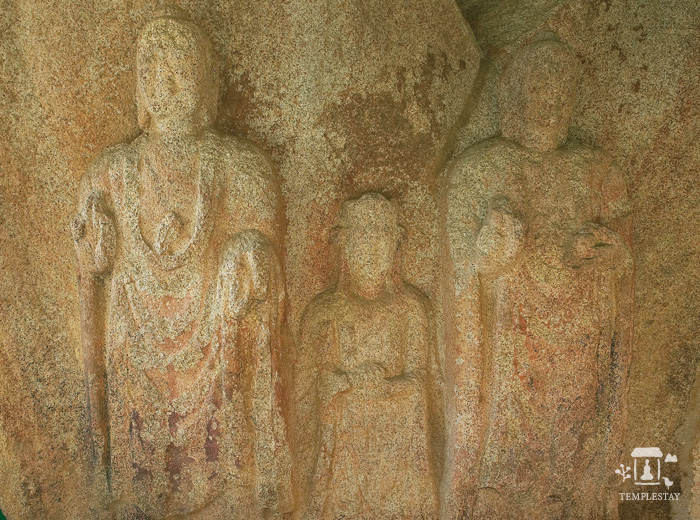
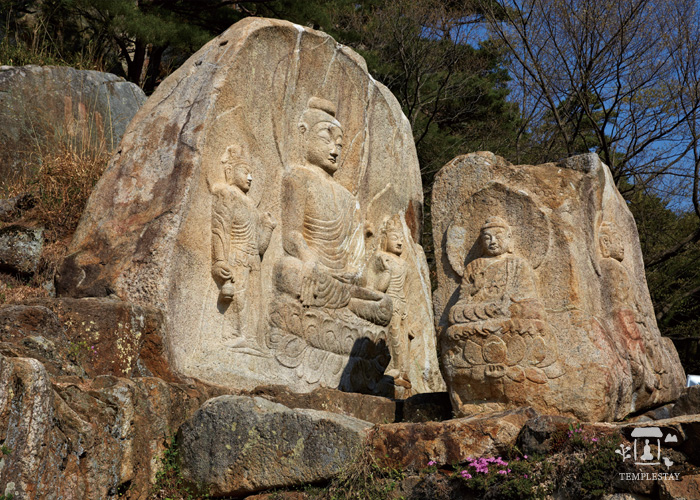
Distinct relics left by Shandong’s Buddhist culture after it was introduced to Baekje are the rock-carved buddhas. In other words, the rock-carved buddhas of the Korean Peninsula first originated in Baekje. One such relic is the Rock-Carved Buddha Triad (national treasure) in Dongmun-ri, Taean, more commonly known as the Rock-Carved Buddhas of Mt. Baekhwasan.
This buddha triad has a unique composition: a small bodhisattva statue standing between two large buddhas. Usually, the buddha is enshrined in the middle, with attendant bodhisattvas or attendant buddhas on either side. In other words, this buddha triad is considered to have been enshrined before the standard pattern of enshrining a buddha triad was established.
In particular, the unique curvature of the fingers‒‒in which the little finger and ring finger are bent—is known to have appeared only from around the 1st year of Emperor Xiaowen’s reign in the Northern Wei Dynasty (477) to the mid-500s. Also, the hem of the robe intersecting in an X shape at the bottom is also a style of early Buddhist statues.
Then why did the Baekje people carve the rock-carved buddha here in Dongmunri?
Upon examining the buddha triad, the surroundings are unusual. It is surrounded by rocks, and there is a spring below the triad. Although there is a road behind the triad, it is not an ordinary place. This tells us it is closely related to a traditional native Korean prayer site.
70% of the Korean Peninsula is mountainous, and the origin of the Korean people also begins in the mountains. The mountains are sacred sanctuaries and places of prayer for the Korean people. The mountains are the arms of our grandfathers and grandmothers who always embrace and protect us, and they are the realm where the spirits reside. The Korean people naturally go to the mountains to pray devoutly and also to practice their religion. In Korea, becoming a monk is also colloquially referred to as “entering the mountains.” The places of worship for shamans are also mainly located in the mountains.

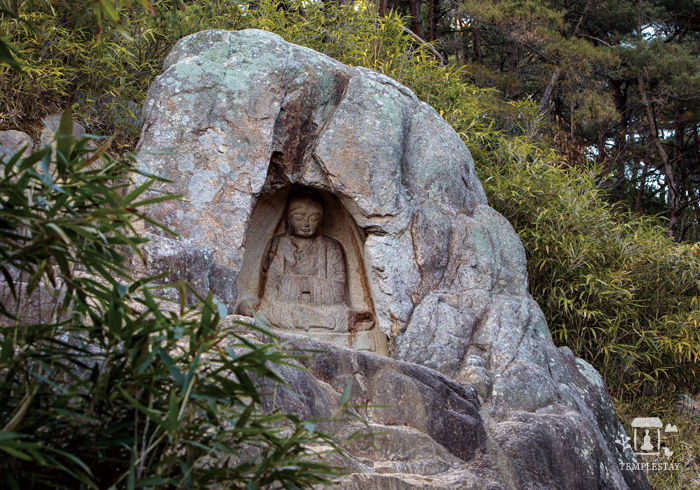
Choe Nam-seon, a Korean historian and political activist, said that Korean culture is characterized by the fact that “stones are symbols of mountains and through them, the sun and the sky are worshipped.” In other words, if there is easy access to water in a secluded place surrounded by rocks, it is often a traditional prayer site. I assume that the rock-carved buddha triad on Mt. Baekhwasan in Taean is exactly such a place. It is believed to have been a place of prayer where local residents would come to offer prayers, even before the rock-carved buddhas were created.
In fact, when I survey various rock-carved buddhas across South Korea, I often find them carved into traditional native rock cliff altars. If there was a place to pray and a spring nearby, buddhas would be carved into the rock and a hermitage would be built.
Encountering the Smile of Baekje
In April 1959, Mr. Hong Sa-jun, director of the Buyeo National Museum, went to investigate the Bowonsa Temple site, and on the way, guided by local residents, he visited for the first time a rock-carved buddha triad, previously unknown to the academic world. It was a historic day when the outstanding rock-carved buddhas of Baekje were revealed to the world again.
This triad, carved in an exquisite location on a rock cliff on a steep mountain slope, had no major damage and retained the appearance of proper Baekje-style buddha and bodhisattva statues. The tranquil smile of the main buddha in the middle, seemingly completely detached from anything, immediately captivated everyone.
The delicate smiles on the lips of the bodhisattvas on both sides were seen by visitors to be the warm, honest smiles of neighbors, not divine beings. It was a masterpiece among masterpieces in which the Baekje people’s skills were fully on display.
Rock-carved buddhas are very important cultural assets in the history of Buddhist culture. Since buddha statues enshrined in dharma halls can be moved due to war, fire, or other disasters, their original locations are often unknown, and might remain unknown. However, rock-carved buddhas cannot be moved, so they serve as definitive evidence of a region’s Buddhist culture.
Although Baekje was defeated in 660, the rock-carved buddhas they left behind are considered the essence of Baekje’s Buddhist culture. The official name of the newfound buddhas is Rock-Carved Buddha Triad of Yonghyeon-ri, Seosan (a national treasure).
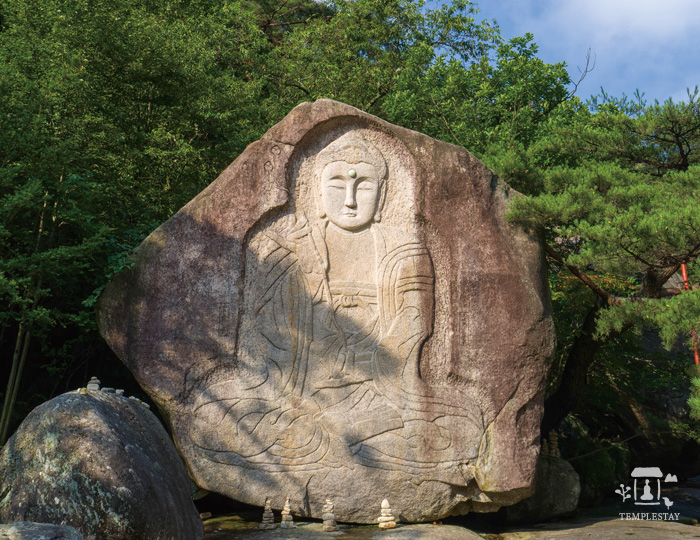
Rock-carved buddhas also appeared in Silla’s capital, Seorabeol, before the unification of the Three Kingdoms. One well-known statue is the Rock-Carved Seated Buddha (Treasure) in Bulgok, located in Bucheogol at the northern end of Mt. Namsan in Gyeongju.
Since ancient times, the people of Gyeongju have called it by the friendly name “Bucheogol Granny Buddha” or “Gamsil Buddha.” The statue was carved into a niche in the rock. At first glance, it looks like a kind and gentle grandmother with a round face, sitting quietly and clad in a hanbok.
Both hands are hidden under the hem of her robe, and only one foot is exposed. The hem of her robe covers the bottom of the pedestal, showing it is an early style of buddha statue, indicating it was created in the closest place to the city of Seorabeol before the unification of the Three Kingdoms.
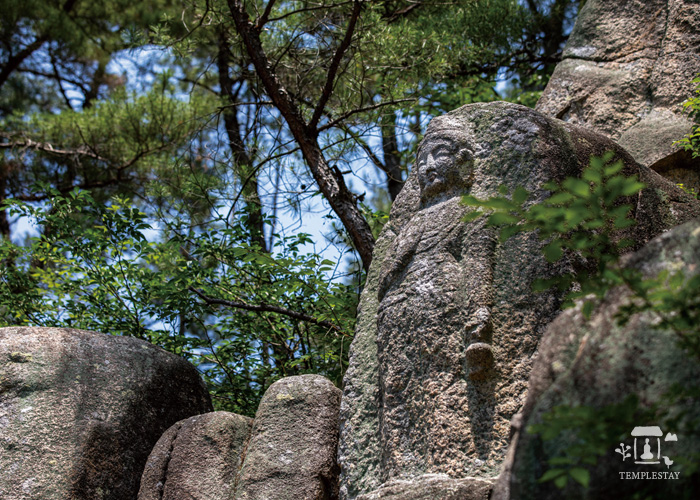
The original name of Gyeongju’s Mt. Namsan was Mt. Geumosan. It is a very rocky mountain about 4km wide and stretches 8km from north to south. As mentioned earlier, rocky areas in the mountains have been used as places of prayer for a long time. There are countless such places scattered across Mt. Namsan with traces of prayer sites dating back to the prehistoric era. Naturally, after the unification of the Three Kingdoms, numerous rock-carved buddhas were created on Mt. Namsan.
Regarding this, Mr. Yun Gyeong-ryeol (1916―1999), also known as “the last citizen of Silla,” said, “The buddha who originally dwelled in the rock revealed his body in response to the people’s earnest prayers.” This means that the sculptor carved the buddha while searching for a buddha that had already existed within the rock for ages.
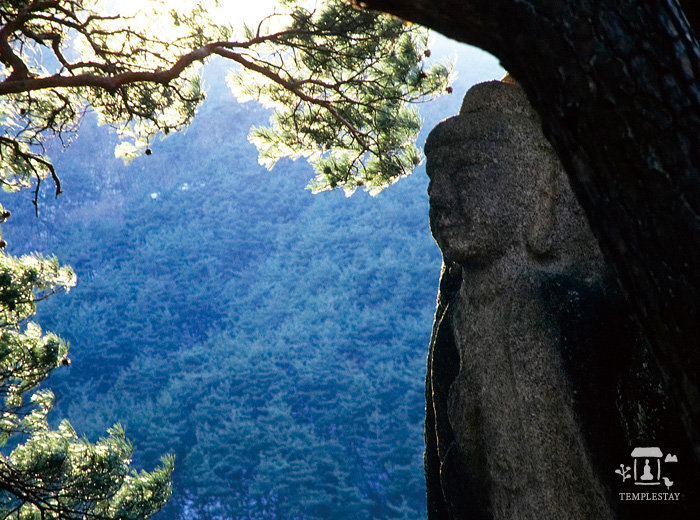
Perhaps that is why, among the many rock-carved buddhas on Mt. Namsan, some are carved with the upper body protruding from the rock and the lower body delineated with faint lines, as if the buddha or bodhisattva was emerging from the rock.
The same goes for the Rock-Carved Standing Avalokitesvara Bodhisattva in Samneung Valley, west of Mt. Namsan. This Avalokitesvara statue has a calm smile on its lips that appear reddish when seen in the light of the setting sun. It is delineated with faint lines near the bottom, which makes it difficult to see the knees. Furthermore, only the bottle held in the left hand stands out, making it look as if the bodhisattva is just about to emerge from the rock. The Rock-Carved Seated Shakyamuni Buddha farther up the Samneung Valley has a similar structure.
There are a total of 118 statues, including buddha statues, on Mt. Namsan. Among them, the most outstanding rock-carved buddhas are, as everyone knows, the Rock-Carved Buddhas (a national treasure) at Chilburam (lit. Hermitage of Seven Buddhas). In front of the buddha triad carved into the rock is a square stone pillar with buddhas carved on all four planes, and since there are seven of them, this determined the name of the hermitage. It is believed to have been carved in the 700s, when Buddhist sculpture in Silla reached its peak after the unification of the Three Kingdoms.
The most representative example of a rock-carved buddha to be found in the former Baekje region is the Rock-Carved Seated Buddha on Mt. Wolchulsan in Yeongam (a national treasure). A shallow niche was carved into the rock cliff, and a huge 8.6m tall buddha was carved into it.
The statue’s semicircular topknot (uṣṇīṣa) rises high above the head, and the face is large compared to the body, giving a dignified impression. The robe is delineated shallowly, revealing all the curves of the body, and the hem of the robe is depicted in an old-fashioned style that reaches down to the pedestal. A small boy holding a lotus flower is carved on the right end of the pedestal, which relieves the solemn atmosphere.
Spreading throughout the Mountains and Rivers
During the Unified Silla period, many rock-carved buddhas were created in the old Silla region, but they began to appear nationwide starting in the Goryeo period.
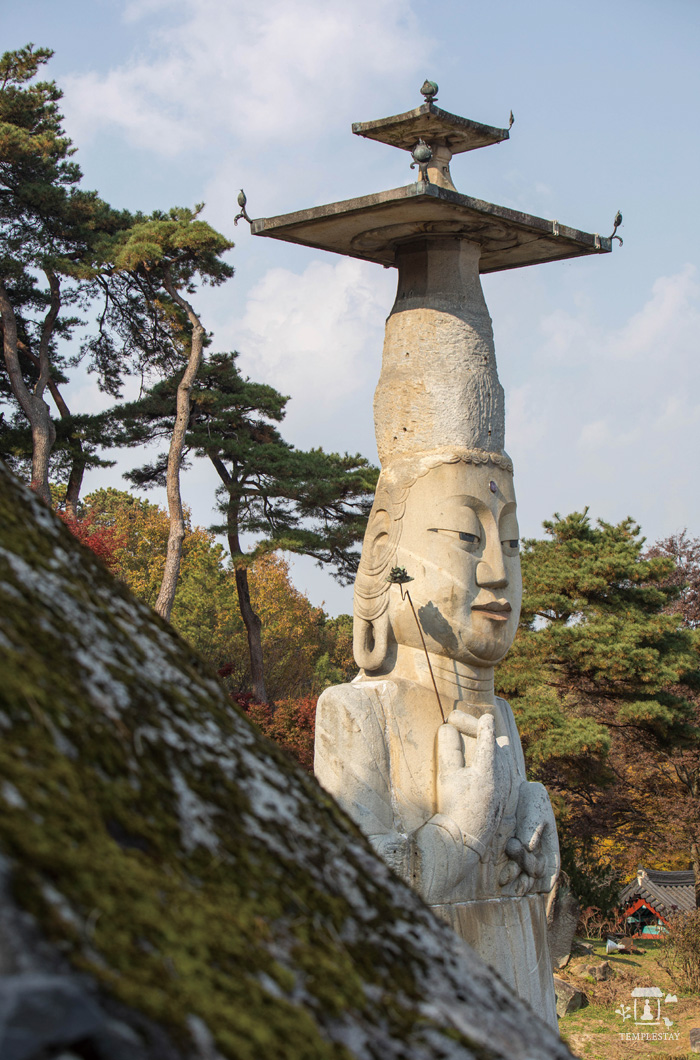
Large stone buddhas were erected everywhere, including the 18m-tall Standing Stone Maitreya Buddha at Gwanchoksa Temple in Nonsan (a national treasure), also called “Eunjin Mireuk.” As the country became more stable, stone carving techniques also advanced. Rock-carved buddhas also became larger and spread throughout the country. The Rock-Carved Seated Buddha on Mt. Geumgangsan, also known as “Myogilsang” is 15m tall despite being in a seated position, and the Rock-Carved Seated Buddha (a treasure) of Seonunsa Temple in Gochang is from the early Goryeo period. It stands 15.7m tall including the pedestal.
The Rock-Carved Seated Buddha in Mureung-ri, Yeongwol boasts a unique location. Nearby is a towering rock peak at the point where the Jucheon River and the Beopheung Valley stream meet, the latter flowing down from Beopheungsa Temple, one of five Korean temples that have a Buddha relic shrine. There is a natural monument called Dolgae-gumeong on the riverbank, a unique landscape featuring natural potholes carved into the bedrock by rocks being tumbled around by the rapidly flowing water.
A huge rock, shaped like a water drop, sits on top of the rocky peak, and a buddha is carved on the eastern side of the rock. Anyone can see that it is a natural prayer site. Here, a buddha hall and a pagoda were also built, but the buddha hall is gone now, and only its pavilion, called Yoseonjeong, remains.
During the Goryeo Dynasty, many buddhas were carved into boulders in the mountains, but they were also erected along important roads. The Rock-Carved Standing Buddha (treasure) in Ichon-dong in Andong—also known as Jebiwon Mireuk—is one example. They were also carved on riverside cliffs so that passersby in boats could also pay homage. The Rock-Carved Buddha in Changdong-ri, Chungju, and the Rock-Carved Standing Buddha in Gyesin-ri, Yeoju are also such relics.
When Buddhism was pushed to the fringes of society during the Joseon Dynasty, the creation of rock-carved buddhas became very rare. The larger the rock-carved buddha, the more expensive it was to create. Scaffoldings had to be installed and skilled stonemasons were required. Since a mistake in stone carving cannot be corrected once it is made, highly skilled stonemasons were required to create them. During the Joseon Dynasty, newly-made rock-carved buddhas were so rare that you can count them on one hand.
If I were to pick one masterpiece among the various rock-carved seated buddhas from the Joseon Dynasty, it would definitely be the Rock-Carved Seated Maitreya Buddha of Bongamsa Temple (a treasure) in Mungyeong. It is located in Baegundae, 700m upstream along the valley from Bongamsa Temple. In front of the buddha is a large flat rock, and in front of that, a clear stream flows between the rocks, forming a small waterfall. It is a good place for anyone to pray.
This Rock-Carved Seated Buddha was created by Ven. Hwanjeok Uicheon (1603―1690) when he stayed at Bongamsa Temple from 1662 to the following year. The Buddha has a round, slender, egg-shaped face. The bridge of the nose is straight and the half-open eyes are soft. The small, tightly closed mouth is neat and solemn, as if in meditation. It is truly a masterpiece of the Joseon Dynasty.
Among the various rock-carved buddhas of the late Joseon Dynasty, the Rock-Carved Seated Avalokiteshvara at Hakdoam Hermitage on Mt. Buramsan, Seoul, can be considered great. This 13.4m tall bodhisattva statue was created in 1872 to fulfill a vow by Queen Myeongseong. It was created the year after she lost her first son, and two years later, King Sunjong was born.
It is the largest rock-carved buddha of the Joseon Dynasty, and the best monk painter on Mt. Geumgangsan, named Jangyeop, drew the outline for the carving, with five stonemasons working together to complete it. It is a precious cultural asset created by an excellent monk painter and several craftsmen.
Then came the Japanese colonial period, and the creation of rock-carved buddhas was taken over by the Japanese. After Korea was occupied, Japanese Buddhist culture appeared in Korea. The Rock-Carved Kobo Daishi (aka. Kukai) and the Rock-Carved Acala Vidyaraja on Mt. Yudalsan in Mokpo are remnants of Japanese Buddhist culture.
There are over 1,000 rock-carved buddhas scattered throughout the Korean Peninsula. They are so common that you might pass them by without giving them any thought, but their origins are important.
Furthermore, they are deeply connected to the traditional beliefs of the Korean people, making them even more valuable cultural assets.
Noh Seung-dae has devoted more than 20 years to visiting various sites and studying Korean cultural heritage with an unwavering passion for our culture. The results have been contributed to magazines like Bulkwang and People and Mountains . His Korean publications include Hidden Supporting Actors in Temples and At Temples Goblins Live and So Does Grandmother Samsin.
Check out more photos >


4th Fl. Templestay Information Center 56 Ujeongguk-ro, Jongno-gu, Seoul, South Korea (03145)
Tel : 82-2-2031-2000 / Fax : 82-2-732-9928
Copyright ⓒ 2020 Templestay webzine. All Rights Reserved.
4th Fl. Templestay Information Center 56 Ujeongguk-ro, Jongno-gu, Seoul, South Korea (03145)
Tel : 82-2-2031-2000 / Fax : 82-2-732-9928
Copyright ⓒ 2020 Templestay webzine. All Rights Reserved.