


Time to replenish my energy

A Meal at a Mountain Temple
H
>Time to replenish my energy
>A Meal at a Mountain Temple

Foods of a Mountain Temple that Help Us Endure Winter
Bodeoksa Temple in Busan
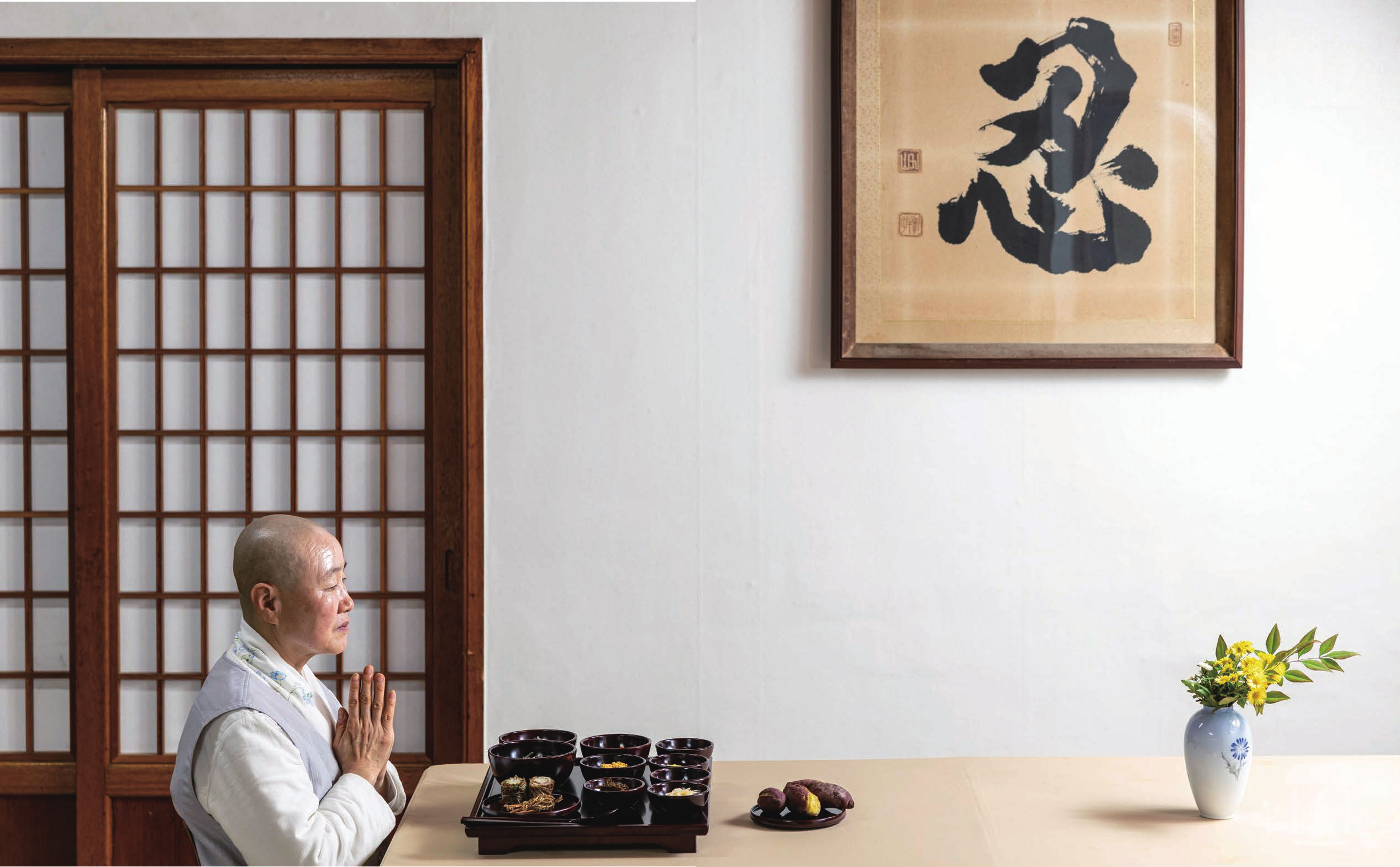
After the vibrancy of spring and summer had passed, the fruits of autumn were
harvested, and the first frost descended on the land. Winter has come again. The
arrival of winter signifies the end of another cycle. It's also a time to gather one's
energy for a new beginning. It's time to bring the mind, previously scattered,
back to a place of tranquility. Perhaps winter is the best season for Buddhist
practitioners. The chilly dawn breeze makes me wonder about the well-being
of the residents of mountain temples. What will they eat this long winter?
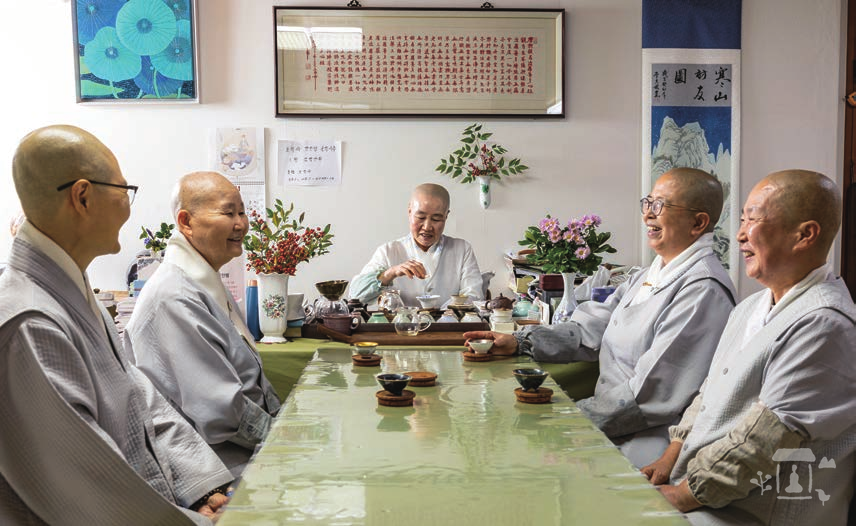
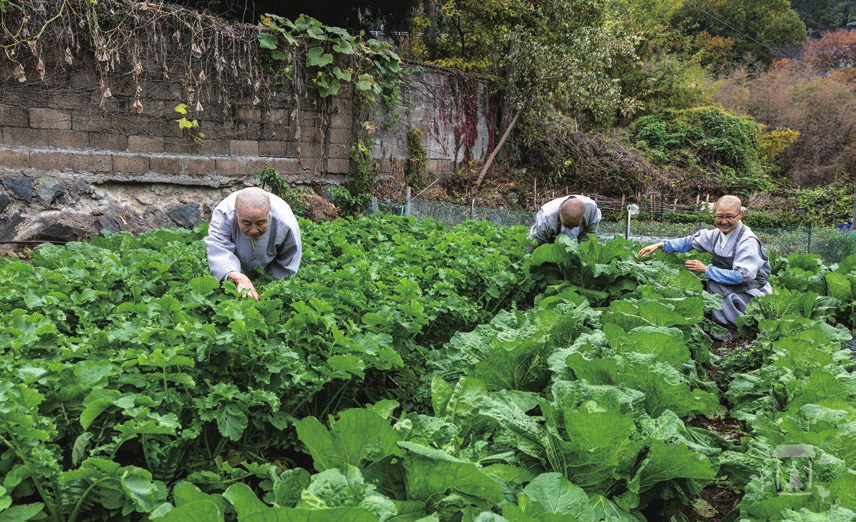
절기의 끝, 사색과 성찰의 계절
The End of a Solar Cycle, a Season for Reflection and Introspection The leaves have already fallen, and the days have grown significantly shorter. The nights have grown longer as much as the days have grown shorter, and in the stillness of night, we breathe more deeply.
Early in the morning, still dark, I hurried to Bodeoksa Temple in Busan. Unlike Seoul, where temperatures often drop below freezing, Busan's winters are relatively mild, as everyone knows. Still, winter is indeed winter, and the wind felt noticeably cold as I ascended the mountain road. Bodeoksa Temple sits on the slope of Mt. Yunsan, a 317-meter-high hill in Geumjeong-gu District, Busan. It's truly a temple in the heart of the city, overlooking the apartment buildings below.
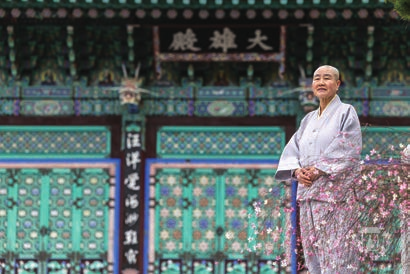
Dorim Seunim, a Grade-1 Temple Food Artisan of the Jogye Order, serves as the abbess of Bodeoksa Temple. Dorim Seunim entered monastic life at Cheongamsa Temple in 1987 under the tutelage of Jihyeong Seunim, and had never cooked before then. Perhaps by some karmic connection from a past life, she immediately began cooking rice and side dishes in the temple kitchen upon becoming a nun. She said that recipes she had never learned before just came to her and she found herself cooking naturally. Since then, she has now been preparing temple food for nearly 40 years.
After offering three prostrations to the Buddha in Daeungjeon Hall and heading toward the dormitory, I noticed some shiitake mushrooms drying beneath the stairs next to the Jangdokdae (platform for earthenware jars of fermented traditional sauces). They seemed part of the landscape. I imagined the early winter midday sun and Busan's sea breeze to be enhancing the mushrooms' flavor and aroma.
"When cooking, vegetable stock and gorosoe soy sauce (soy sauce brewed with mono maple sap) are crucial. That's the secret to a rich flavor," said Dorim Seunim.
Dried shiitake mushrooms are used to make vegetable stock. Other ingredients include radish, kelp, cabbage, Cheongyang chili peppers, and bean sprouts, all of which are added to the veggie stock. There are no set ingredients. Just add all parts of the vegetables, even the stems, and simmer till done. Leftover vegetable stock can be sprinkled around the tree trunks to nourish them. Nothing is wasted.
Throughout all four seasons, nature's bountiful offerings must be considered as medicine that enables monastics to perform their fundamental duty, which is to practice diligently and attain enlightenment. Just as all things are impermanent, our bodies too will eventually die and return to the earth. Are practitioners the only ones who experience this impermanence? Gazing at the dry, naked branches, I sense the end of another cycle. Winter is a season for reflection and introspection, a time to pause from our hectic lives and reflect on the path we have chosen.
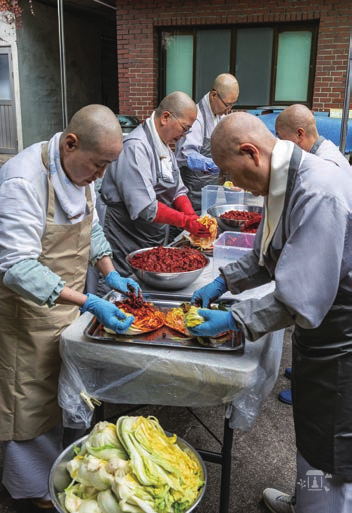
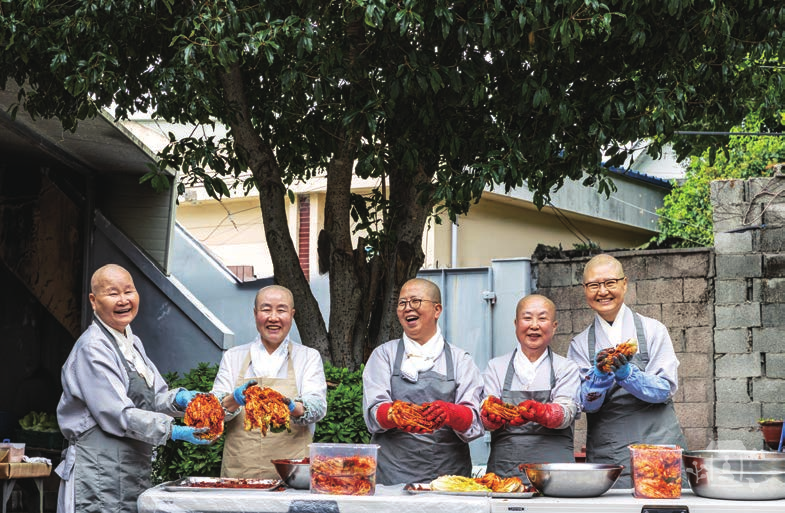
Temple Kimchi without the Five Pungent Veggies
Just as in secular life, winter preparations at a temple begin with making kimchi (gimjang ). While fewer and fewer households do gimjang these days, and more people buy kimchi, the situation is different at temples. Gimjang is a must at temples because their kimchi must be made without the five pungent veggies and without salted seafood; also because both monastics and devotees eat kimchi in a communal setting.
To help with kimchi-making, Dorim Seunim's fellow nuns, both senior and junior to her, have traveled from afar to Bodeoksa Temple early in the morning. They plan to turn about 150 heads of napa cabbage into kimchi, cabbage grown directly on the temple farm.
Reminiscing, Dorim Seunim said: "In the past, during gimjang season at Cheongamsa Temple, we would use over 1,000 heads to make kimchi. Between midnight and 2 a.m., we had to turn over every salted cabbage once. Imagine the cold and exhaustion of the dozen or so nuns tasked with doing this on a cold winter night. Back then, we didn't even have padded jackets like we do now. We shivered to the bone."
Compared to those days of making kimchi from 1,000 heads of cabbage, 150 heads of cabbage was child's play. Except for the time- consuming task of brining the cabbage, the rest was done in a flash. Every step unfolded swiftly and precisely, as if scripted. The nuns' skillful hands and working in harmony were the secret.
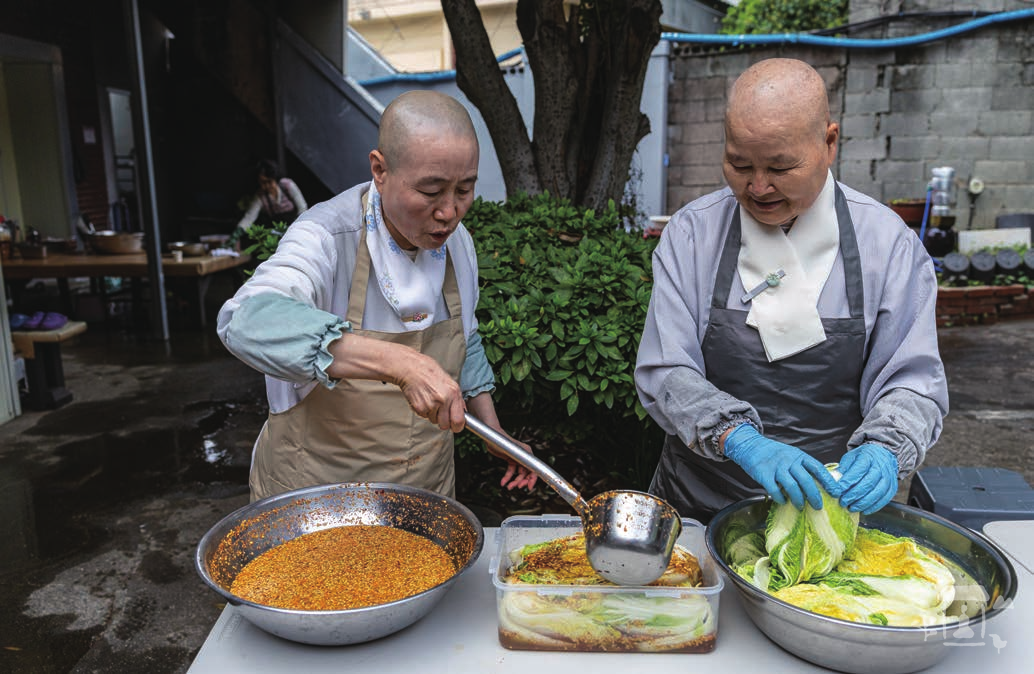
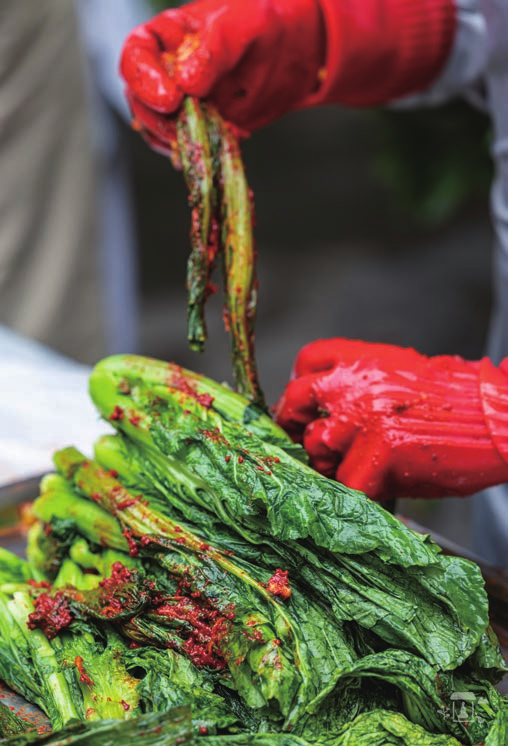
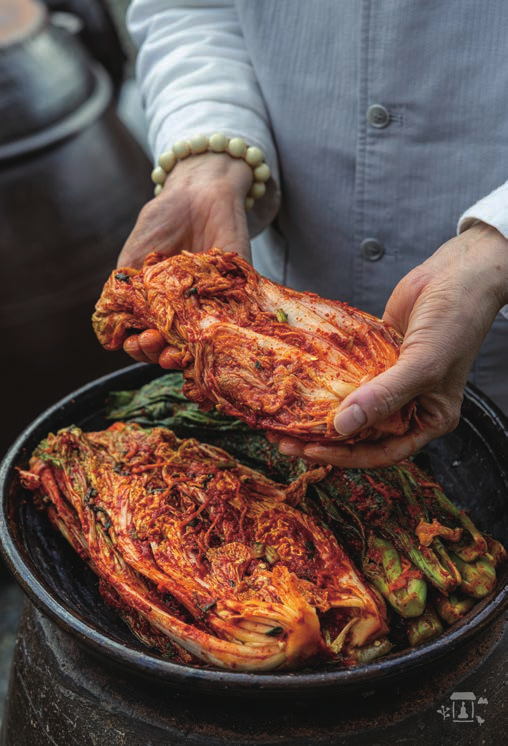
Using nature's generous offerings as medicine for their practice, practitioners diligently practice throughout the year. Just as everything is impermanent, our lives, too, will eventually end, and we will return to our original state.
Dorim Seunim shared one secret: "First, you need to salt the cabbage just right. If you salt it too much, it will become tough and tasteless. Just the right amount will keep it crunchy and fresh."
That is easier said than done because figuring out what is "just right" is the tricky part. They say they brine the cabbage by feel and with no complex calculations. I took a bite of the cabbage Dorim Seunim had already pickled, and found the saltiness and texture just right.
The kimchi seasoning, which determines the flavor, featured unique ingredients, as befitting temple kimchi. Along with shredded radish, Dorim Seunim added sliced mustard leaves instead of the five pungent veggies like green onion and garlic that a secular household would use. She also added her homemade fish mint syrup, plum syrup, wild peach syrup, and ginger extract. To these, she added lotus root porridge, which is made with lotus root powder and is said to keep the cabbage crisp for years. Finally, other essential ingredients were the vegetable stock and gorosoe soy sauce. She sometimes adds boiled pumpkin to the vegetable stock to add sweetness.
Spreading kimchi seasoning on pickled cabbage may seem simple at first glance, but there's a trick to it. It's said that when kimchi is to be eaten immediately, a generous amount of seasoning should be applied, and when kimchi is to be stored for a period of time, a thin layer should be applied sparingly to achieve the optimum flavor.
As I was observing the kimchi-making process and running small errands, Dorim Seunim held a rolled-up piece of kimchi in her hand and motioned for me to open my mouth. Slightly bewildered, I complied and she fed it to me like a baby bird. The joy of savoring freshly made kimchi is unparalleled. The crunchy texture of the cabbage, combined with the refreshing, spicy seasoning, was incomparable. My mouth continued to water even after I swallowed.
Next, the nuns made mustard kimchi with the remaining kimchi seasoning, and with the remaining cabbage, they made chili pepper seed kimchi. Chili pepper seeds contain compounds that are good for preventing cancer, improving blood circulation, and reducing body fat. Despite these health-enhancing qualities, only their oil is extracted and used. After much deliberation on how to use them, Dorim Seunim decided to make kimchi with them.
The recipe is simple. First, place the salted cabbage in a kimchi container. Then, pour in the veggie broth made from gorosoe soy sauce, various syrups, ginger extract, lotus root powder, and chili pepper seeds. They said it can be eaten right away without fermenting, so I tasted it. It was a refreshing kind of water kimchi with a rich broth and savory chili pepper seeds.
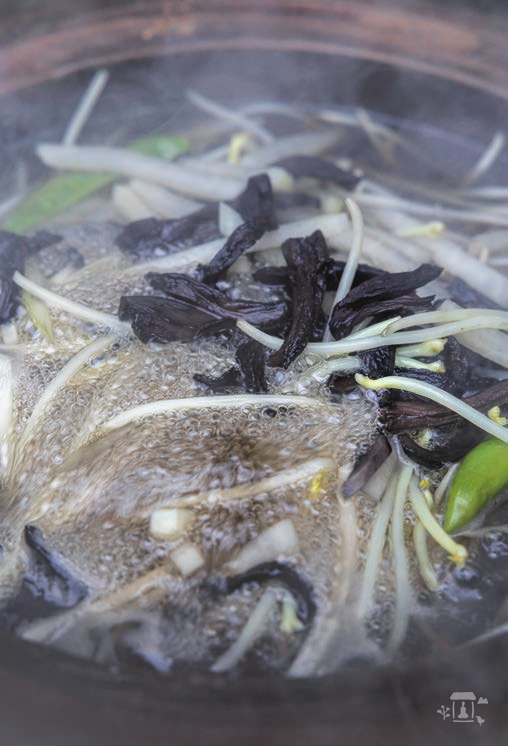
Black Trumpet Mushroom Soup Good for Replenishing Energy and Preventing Colds in Winter
During winter, many monks and nuns enter the winter practice retreat. Motivated by the harsh cold of a mountain temple, they dedicate themselves to 100 days of investigating a hwadu. During this time, consuming energizing foods can aid their practice. To avoid colds, especially in a Seon hall where people practice together, it's beneficial to consume hot foods to warm the body.
In winter, the nuns at Cheongamsa Temple consume black trumpet mushroom soup. When a cold wind blows and one or two people began coughing, the elder nuns light a fire in the hearth and prepare a cauldron. On those days, neungi (black trumpet mushroom) soup is invariably served as a nutritious meal. Although they only eat it once or twice a year, after downing a large bowl of soup, their bodies feel warm throughout.
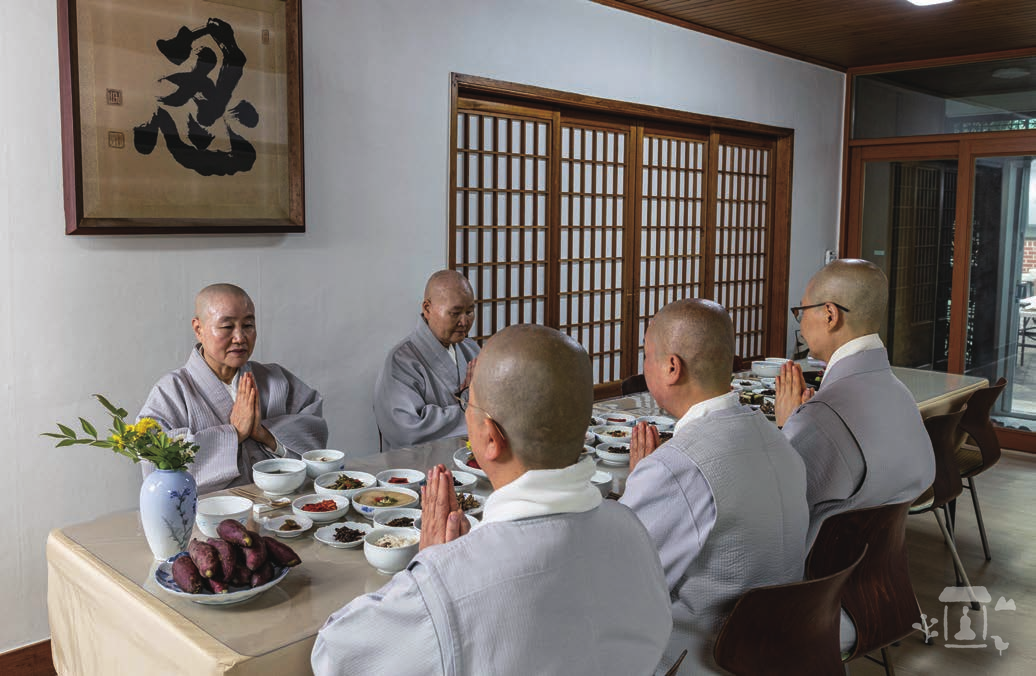
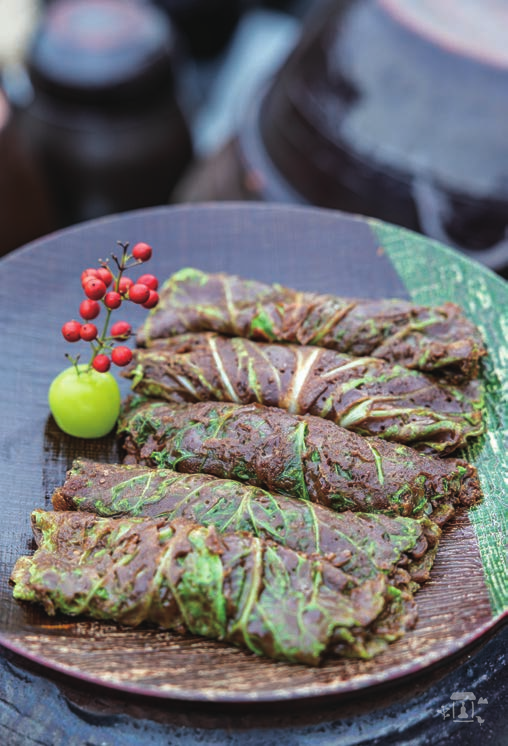
Dinner offering time; a hearty bowl of black trumpet soup, cabbage rolls, and freshly made kimchi all come together on the table, creating a healthy winter meal at a mountain temple.
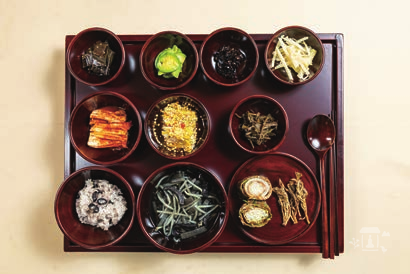
Dorim Seunim reminisced: "On days when we ate neungi soup, the elder nun would always keep the fire burning to warm the ondol floor so we could sleep warm."
Perhaps it wasn't just the efficacy of black trumpet mushrooms that enabled us to endure the cold with just one bowl of neungi soup. Dorim Seunim added, "Back then, I felt the senior nuns were just strict and scary, but now that I think about it, I realize that their concern for the students was reflected in the mushroom soup."
Recalling the flavor of the original soup, she simmered vegetables, soaked neungi, shredded radish, bean sprouts, and Cheongyang chili peppers in a cast-iron pot. Instead of salt, she seasoned the soup with gorosoe soy sauce.
She elaborated, "If you climb up the ridge above Cheongamsa Temple, there's a field of wild neungi. The nuns and I would pick them, prepare them, dry them, and even give them as gifts to our teachers. Freshly picked neungi dipped in sesame oil and salt are delicious. Back then, sesame oil was so hard to get that we'd hide it in the attic and only bring it out for special guests. I remember sneaking it out and dipping neungi in it without the nuns' knowledge."
While the neungi soup simmered, the other nuns prepared cabbage jeon. When trimming the cabbage harvested from the field, they saved the tough, stiff outer leaves for cabbage soup and set aside the tender leaves to make jeon. They gently pounded the thicker, upper parts of the cabbage leaves, dusting both sides with flour to ensure the batter adhered well. They mixed a little flour into the acorn and lotus root powder to make a batter. They dipped the cabbage leaves in the batter and fried them in perilla oil until golden brown. They stir-fried salted radish shreds in perilla oil, put them atop the cabbage jeon, and rolled them tightly, completing the cabbage rolls. The fragrant perilla oil, the soft cabbage, and the crunchy radish slices combined to create a delicacy like no other.
For the dinner offering, a tableful of simmered neungi soup, cabbage rolls, and freshly made kimchi all come together to create a healthy winter meal at a mountain temple.
Dorim Seunim said, "Eating neungi soup after such a long time brings back memories of the hardships I faced at Cheongamsa Temple. Winter was agonizingly cold, the temple was poor, and I was constantly scolded by the senior nuns... Back then, all I wanted to do was run away. Looking back, it was a difficult time, but somehow truly enjoyable and wonderful."
Some foods evoke memories and a feeling of nostalgia from the times we ate them. I believe such foods possess the power to heal.
The next morning, after exchanging greetings with the nuns, I was about to leave when Dorim Seunim handed me the kimchi we'd made together, carefully wrapped in a cloth.
She said: "This is temple kimchi, the kind you can't buy with money, so take it with you, even if it's a bit heavy."
As I gratefully carried the kimchi back to Seoul, I felt like the richest person in the world. This winter, I will endure the cold with Bodeoksa Temple's kimchi. The food that will help me survive the winter is right here.



4th Fl. Templestay Information Center 56 Ujeongguk-ro, Jongno-gu, Seoul, South Korea (03145)
Tel : 82-2-2031-2000 / Fax : 82-2-732-9928
Copyright ⓒ 2020 Templestay webzine. All Rights Reserved.
4th Fl. Templestay Information Center 56 Ujeongguk-ro, Jongno-gu, Seoul, South Korea (03145)
Tel : 82-2-2031-2000 / Fax : 82-2-732-9928
Copyright ⓒ 2020 Templestay webzine. All Rights Reserved.