


Time to understand our traditions

Everyday Occurrences
H
>Time to understand our traditions
>Everyday Occurrences

Paradox of Snow
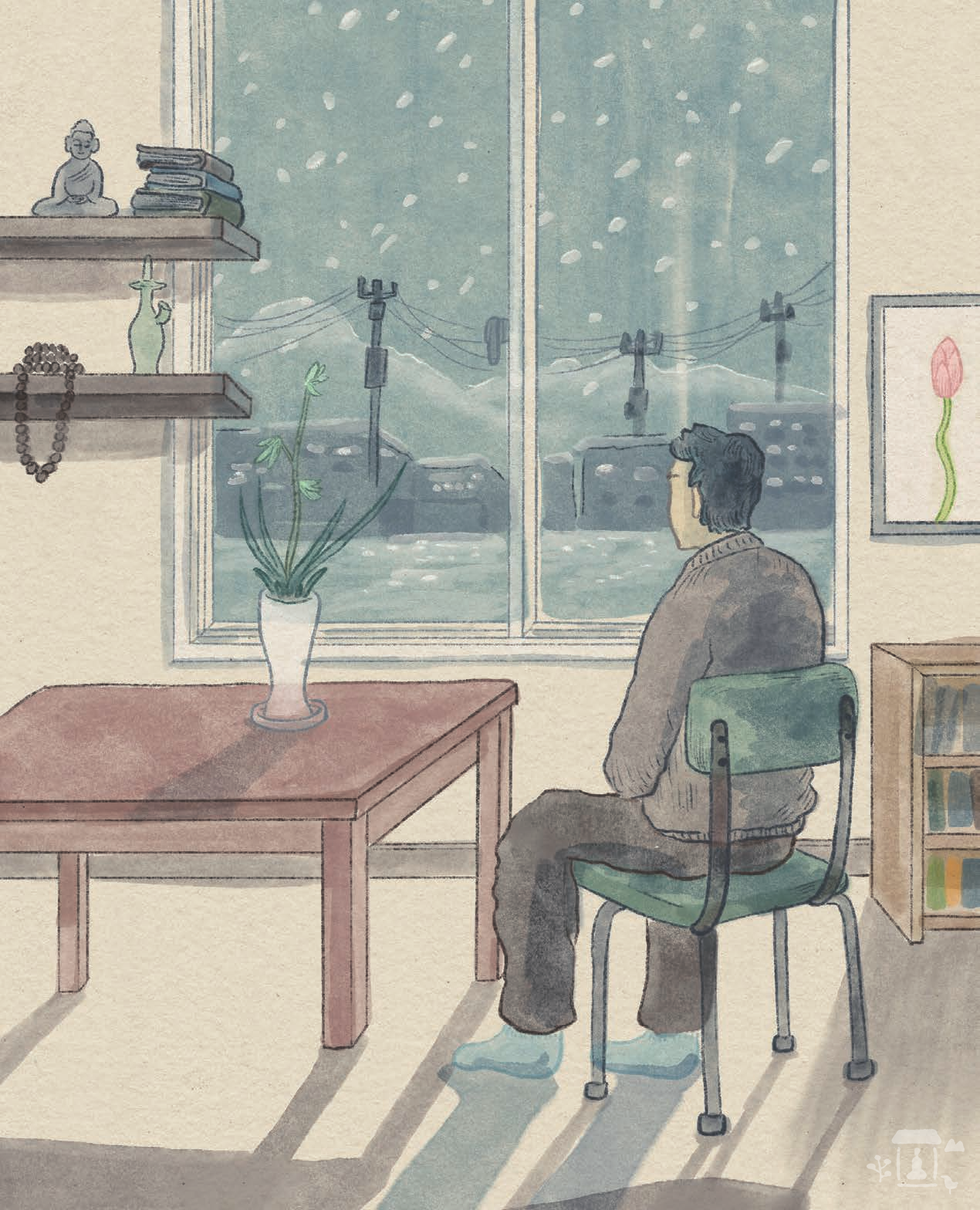
When snow falls, we learn how to walk again. We shorten our stride, slow down, and feel the wind's touch. In that moment, our bodies remember humility. When the pace of our steps matches the pace of our hearts, the world becomes a place of practice for a moment. Footprints left in the snow are soon covered again. The rhythm of covering and revealing, of birth and death, continues quietly beneath our feet. The breath of the world, coming and going in every moment, is audible within.
I recently returned to Seoul after living in Gwangju for a year, a place I had no special connection to. This year, it was often overcast in Gwangju. The rain fell without warning, and sleet and heavy snowfall were frequent. On the day the first snow fell, I listened to music all day. In Korea, the term "first snow" carries an emotional current. It snows every winter, but there's always a "first snow." The first occurrence of a series of repeated events, its paradox offers profound insight. Even in the endless repetition of daily life, we must not lose the perspective of seeing things as if it's the "first time."
In Buddhism, the term "beginner's mind" is perhaps another name for that perspective. Waiting for the first snow is more about waiting for the restoration of our senses than about the weather. Some people make promises when the first snow falls. They arrange meetings, seek reconciliation, and celebrate the beginning and end of relationships. We live by translating the rhythms of nature into social ones. In that moment of translation, snow becomes more than just an event; it acquires meaning.
Every snowflake that falls from the sky is unique. Within clouds, water droplets and ice particles compete for water vapor. The water droplets evaporate, and ice crystals grow larger. Snow is not the result of competition, but of achieving balance. Only when the different states coexist does a single snowflake become complete. As with all things, the world is interconnected through a web of relationships.
No one hears the snowflakes hitting the ground, yet the world soon turns white. That whiteness doesn't cleanse us, but rather silences all sound. Yesterday's wounds, fights, and regrets all lose their luster in the snow, fading into a faint glimmer. Standing by the window, I think of the people I once knew now living far away. The alleys we walked together, the rooftops we played on, must be covered in white by now. That thought alone strangely eases my heart's pain. Even as we live, there are some memories that cannot be erased. Things we hated, words we regretted, moments when that was all there was. The snow quietly blunts the edges of those feelings.
The white surface of the fallen snow soon absorbs dust, dirt, footprints, and soot, becoming stained. These stains are not the destruction of purity, but the conditions for its reestablishment. A place where discrimination ceases, where cleanliness and dirt become shadows of each other. Just as the surface of the snow accepts everything, Buddhist practice, too, seeks not filtered purity but inclusiveness.
Snow covers everything, yet simultaneously reveals something more clearly: the skeleton of a tree, the slope of a roof, the incline of a road. Only then does the structure of the world, previously invisible, finally emerge.
Persistent snowfall obscures vision, but like tracing paper, it diffuses the city lights, creating a soft glow. The noise of cars is suppressed, and the world becomes quieter. Then, we suddenly realize how chaotic our own minds have become. The city's rhythm slows, and people simultaneously look up toward the sky holding their phones.
Such brief spontaneity is the renewed "sensus communis" in the digital age. We pause for a brief moment along with our fellow humans. Everything is covered, and the moment it is covered, it disappears. Perhaps true Buddhist practice is the practice of cessation. Monks call snow "the compassion of impermanence." Covering everything, yet possessing nothing.
In a moment that exists without grasping, the snow melts on top of my shoes, revealing the truth.
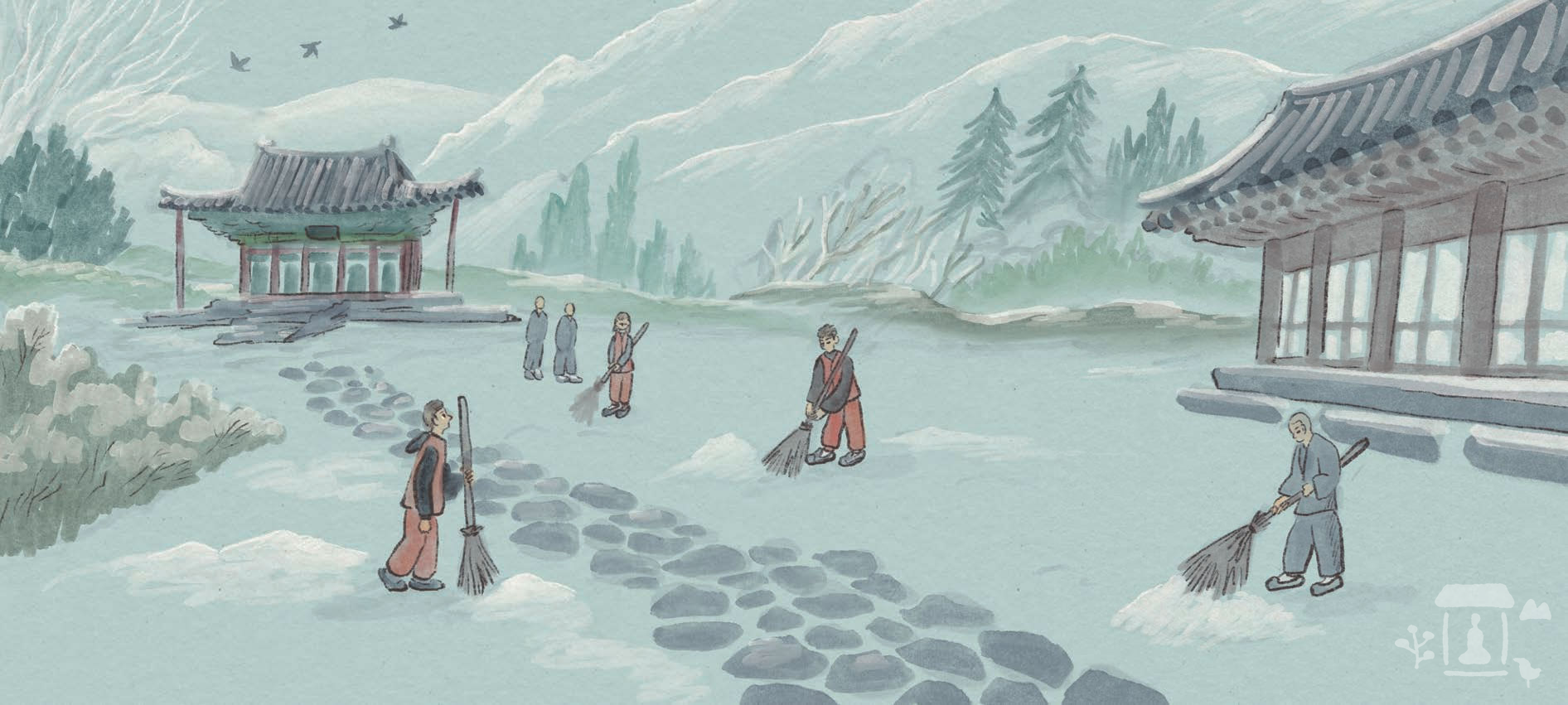
A snowy mountain temple is a place where silence exists before words. I recall last winter at Baekyangsa Temple in Jangseong. As I prepared for the dawn ceremony, the young man in the next room returned after his nightly rounds. On snowy days, he stayed outside longer, clearing a lattice-like path in the courtyard of the main buddha hall. After the breakfast offering, the fourfold assembly all swept the grounds with bamboo brooms. A staff member used a blower to clear the snow from the main path, and Templestay participants joined in the communal work in small groups.
In the past, monks would explain the significance of communal work (ullyeok), saying, "Even ullyeok is a part of Buddhist practice. Moving together is Seon." But these days, ullyeok is limited to brief experiences in Templestay programs, making it difficult to convey the context. For modern people, already burdened by excessive tasks, ullyeok can be seen as just another task. Nevertheless, some people, despite their exhaustion, participate in ullyeok.
"Shoveling snow is a way to cultivate one's own mind." These words from a Seon monk resonated with the participants. Being covered, swept clean, and being covered again: Snow becomes the motivation for endless cycles of practice.
One participant observed, "The endlessly falling white snow wasn't outside of me; it was falling inside me."
The snow of afflictions, the snow of desire, the snow of memory. Even if you sweep it all away, it inevitably falls again. Clearing the snow is ultimately a matter of confronting your own mind.
After the dinner offering, I stepped out into the courtyard. Snow was falling again. The area I had swept during the day was already covered in fresh snow. A sudden smile crossed my face as I pondered the futility of it all. Even the afflictions of the mind eventually return.
As night deepened, the temple was once again immersed in white. The sound of wind chimes was heard from afar. No matter who cleared it or left it alone, the snow continued its mission. It covered, erased, and covered again. The snow didn't remember where it had fallen. It briefly settled on the ridges of roofs, treetops, and even people's shoulders, then vanished. In those brief moments, the world changed, little by little. The snow melted and became water, and the water seeped back into the ground, nourishing the grass and flowers. Our sorrows and joys are part of that cycle. Falling and disappearing, covering yet not erasing, disappearing yet remaining. Perhaps true compassion is like this. It doesn't seek to save the world, but merely temporarily covers it for a while. Ultimately, it transforms everything to a single color.
Snow marks the end of one cycle while preparing for the next. In that pure white cycle of transmigration, all beings already know they will eventually cease. Yet, this very cessation is the most beautiful way to remain in the world.
A drop of water, a handful of light, a breath. When they all merge again and fall from the sky in white, we are surrounded by those who have briefly returned. Ten centimeters of snow preserves the warmth of the earth, enveloping the delicate roots of grasses and enabling them to endure the winter. Beneath a surface that looks like white death, life still breathes. Not a passionate embrace, but a quiet covering. Instead of directly touching a wound, it is a quiet covering like snow, allowing time for it to heal beneath.
Snow covers everything indiscriminately. It quietly piles up on ruins, cathedral roofs, trash cans, and even abandoned scooters. In this nondiscriminatory covering, we finally learn the right of all beings to rest for a moment.
Snow in one country can have an entirely different significance in another. Yet, all snow conveys a common message: "Pause and rewrite your world."
Snow is like a stop sign for humanity. Despite differences in nationality and language, in that moment of white silence, we all pause beneath the same sky. When melted snow forms clouds again, and those clouds fall as snow again, we finally realize that only that which disappears connects the world.
Everything exists through interconnected relationships. Emptiness is not truly empty, but a fullness filled with relationships. Snow is the perfect metaphor for those relationships. It accumulates indiscriminately on all things, and melts in different ways within all things. Purity does not exist in isolation, but is maintained within a web of interdependent arising. Therefore, the purity of snow is not a perfection that rejects the secular world, but a transparency that embraces it.



4th Fl. Templestay Information Center 56 Ujeongguk-ro, Jongno-gu, Seoul, South Korea (03145)
Tel : 82-2-2031-2000 / Fax : 82-2-732-9928
Copyright ⓒ 2020 Templestay webzine. All Rights Reserved.
4th Fl. Templestay Information Center 56 Ujeongguk-ro, Jongno-gu, Seoul, South Korea (03145)
Tel : 82-2-2031-2000 / Fax : 82-2-732-9928
Copyright ⓒ 2020 Templestay webzine. All Rights Reserved.