


Time to find myself

Pilgrimage Trails to 33 Avalokiteshvara Temples
H
>Time to find myself
>Pilgrimage Trails to 33 Avalokiteshvara Temples

Forest of the Heart, Path of Faith
Beopheungsa Temple in Yeongwol
Before entering parinirvana, the Buddha said, "If there's anything you don't know,
ask now." The disciples remained silent. The Buddha reiterated the question, but
no one spoke. Ananda then said, "This assembly has no questions." It wasn't that
the disciples had no questions, there was simply no need to ask them. Everything
had already come to light through the teacher's teachings, so why bother asking
questions? After the Buddha's passing, a cremation ceremony was held. The
Buddha's ashes were dispersed by the wind in a fiery blaze, leaving behind his
cremains (sarira). Over the years, these sarira were carried to various places around
the world, even to Mt. Sajasan in Yeongwol, Gangwon-do Province in South Korea.
These are the authentic relics that countless devotees venerated with deep faith
for thousands of years. Today, this pilgrim, still unenlightened, visits Mt. Sajasan.
Before paying homage to the Buddha's sarira, I ask myself: "What is faith?"
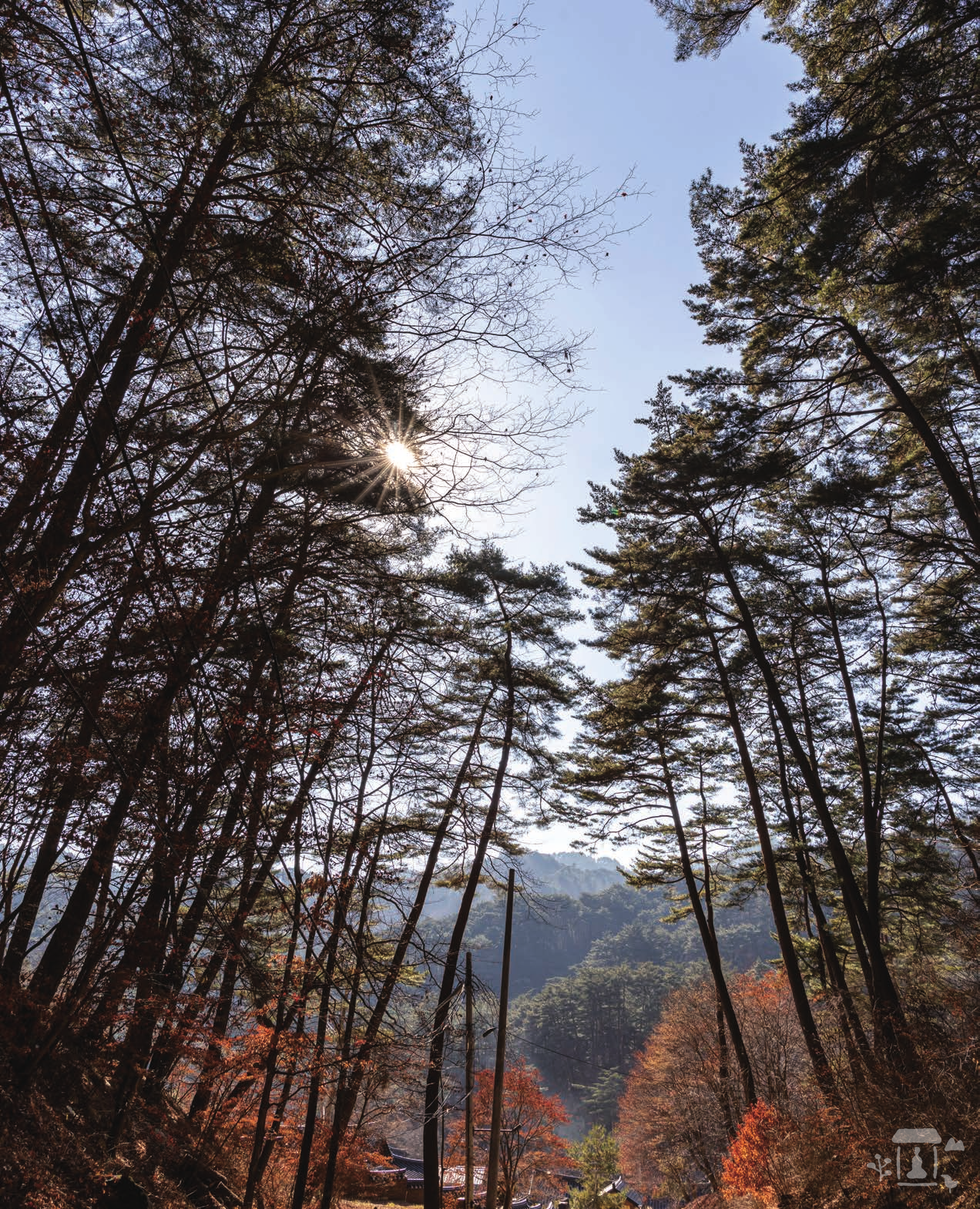
The slopes of Mt. Sajasan—1,180 meters above sea level—are mostly covered in pine trees. The forest is so dense that even the sky struggles to penetrate it as we walk along the quiet path to Beopheungsa Temple. The sun's rays that manage to filter through the trees, strike the ground, appearing to dance. Suddenly a breeze arises. The drooping pine branches rustle in the breeze, whispering an audible swooshing sound. Mt. Sajasan itself seems to sway, as if stretching after a deep afternoon nap. This ballet of light and tree branches welcomes all pilgrims. I breathe in the pine-scented air. The pristine nature spreads from my heart through my entire body. Mt.
Sajasan exudes warmth in quiet silence. Passing Iljumun Gate and Woneumnu Pavilion, I stand in the front courtyard of Geungnakjeon Hall. The ridgeline of Mt. Sajasan is barely visible through the pine trees. Somewhere on this beautiful mountain lie the authentic sarira of the Buddha. And now, we arrive at that place where, in the distant past, Vinaya Master Jajang brought the Buddha's sarira. With palms together in gratitude, we bow.
Toward the Inner Self, Toward the Buddha's Sarira
Born in Silla in 590, Jajang was deeply interested in Buddhism from an early age. Defying a royal request to become a high-ranking official, he entered monkhood and studied in Tang China, intent on awakening to the heart of Buddha-dharma. While praying on China's Mt. Wutai, he had a mystical experience. In a dream, Manjusri Bodhisattva appeared to him and recited a verse in Sanskrit, but he was unable to understand it as he did not know Sanskrit. The next day an old monk paid a visit to him and said, "The four-line verse you heard in your dream means: If you realize the true nature of all things, you will know that your true self has no need for possessions. If you realize this truth, you will immediately see Locana Buddha." The old monk then handed Jajang the Buddha's sarira and disappeared.
Returning to Silla, Jajang enshrined them on four different mountains: Yeongchuksan, Seoraksan, Taebaeksan, and Odaesan. In 643, he enshrined them on Mt. Sajasan and established Beopheungsa Temple.
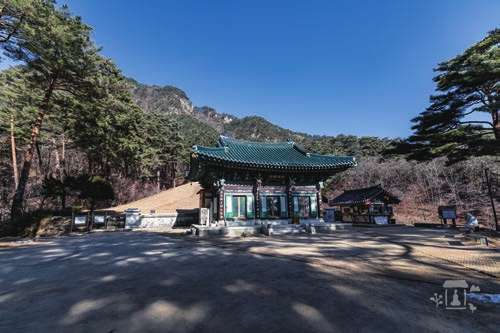
We climb the mountain slope again beginning from the front courtyard of Geungnakjeon Hall. The narrow path, encroached upon by trees, is veiled in layers of shadows. The shadows cast by the clouds and mountain ridges block most of the sunlight, and the scent of pine trees that lingers in the air is stronger than the scent of flowers. After walking for about 20 minutes, we reach the end of the trail, where Mt. Sajasan suddenly pushes back the forest to reveal a small flat plain. Light streams into the open space, hurting our eyes which had become accustomed to the shadows. We walk the rest of the trail and reach the buddha hall at the end. We stop and look at the door plaque, which reads, "Buddha Relic Sanctuary (Jeongmyeol- bogung)." We have finally arrived. This is Beopheungsa Temple's Jeongmyeol-bogung Hall, where the Buddha's sarira are enshrined.


Faith Is Everywhere
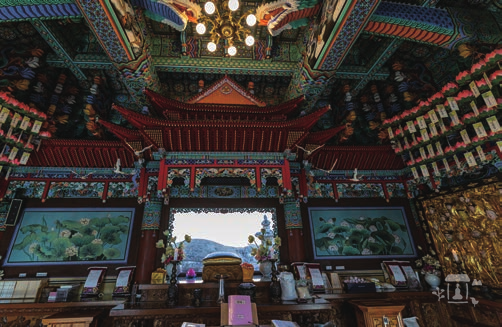
There are no buddha statues in Beopheungsa's Buddha Relic Sanctuary. Where a buddha statue would normally be is a glass window that looks out to the hill behind the sanctuary, where it is said Jajang buried the Buddha's sarira. Where could they be? Are they still there? Are they really buried there? I ponder these questions, but my heart remembers the lush pine branches, the sunlight filtering through them, the wind fragrant with the scent of pine, and my true self spontaneously being revealed. If I don't think of myself as different from you, only the single fact remains that the sunlight and the scent of pine are myself, and I understand that "One is all." With a clearer mind, I put my palms together. The Buddha's sarira lie on the hill behind Beopheungsa's Buddha Relic Sanctuary. They reside in my heart, and my heart is a buddha's heart.
After paying homage to the sarira, I ask myself again: "What is faith?" On my way down from Mt. Sajasan, the ongoing ballet of light and shadow is beautiful. Beneath the sky, the mountain's curves flow like a river. The landscape—which embodies non-duality and the compassion of Avalokitesvara Bodhisattva—continues to illuminate my eyes. And, as always, my heart will always believe and remember that truth abides everywhere.
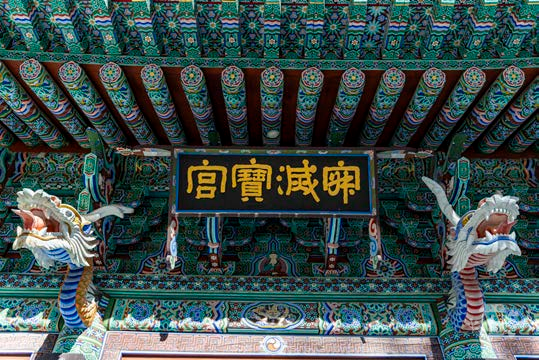
Buddha Relic Sanctuary (Jeongmyeol-bogung)
Beopheungsa Temple was founded in 643—the 12th year of Silla's Queen Seondeok's reign—by Vinaya Master Jajang. It was then called Heungnyeongsa Temple. In 886, Great Master Jinghyo established the Sajasan School here, one of the Nine Mountain Schools of Korean Seon. For a time, thousands of Seon practitioners gathered there to practice, enjoying its heyday. Heungnyeongsa Temple fell into ruin, but was rebuilt in the early Goryeo Dynasty with the support of a powerful clan. During the Joseon Dynasty, Heungnyeongsa Temple experienced repeated fires and reconstructions, ultimately leaving only the Buddha Relic Sanctuary intact. In 1902, Daewongak Seunim rebuilt it and renamed it Beopheungsa Temple. After another fire in 1912, the Buddha Relic Sanctuary was relocated to its current location, facing Mt. Sajasan, where Vinaya Master Jajang is said to have buried the Buddha's sarira.

Stone Chamber Tomb and Monk's Stupa
Located behind the Buddha Relic Sanctuary is the stone chamber tomb (seokbun) of Beopheungsa Temple, said to be where Vinaya Master Jajang cultivated the Way. The cave, which appears at first glance to be a burial mound, has a square entrance, while the interior has a flat floor and walls that curve inward. Legend has it that Jajang meditated in this narrow space—measuring 1.6 meters wide and 1.9 meters high—surrounding himself with thorny bushes. It is now designated as Gangwon-do Tangible Cultural Property No. 109. The monk's stupa (budo) of Beopheungsa Temple—designated Gangwon-do Tangible Cultural Property No. 73—stands guard beside the stone chamber tomb. The identity of the cremains enshrined within is unknown, but it is commonly referred to as a sarira stupa. Carved with lotus flowers and guardian deities who protect the Buddha-dharma, this stupa, along with the stone chamber tomb, adds to the solemn atmosphere.
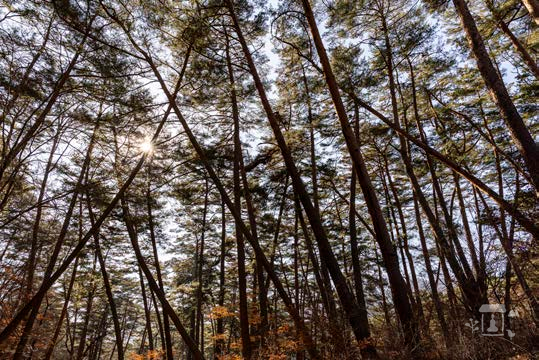
Pine Forest
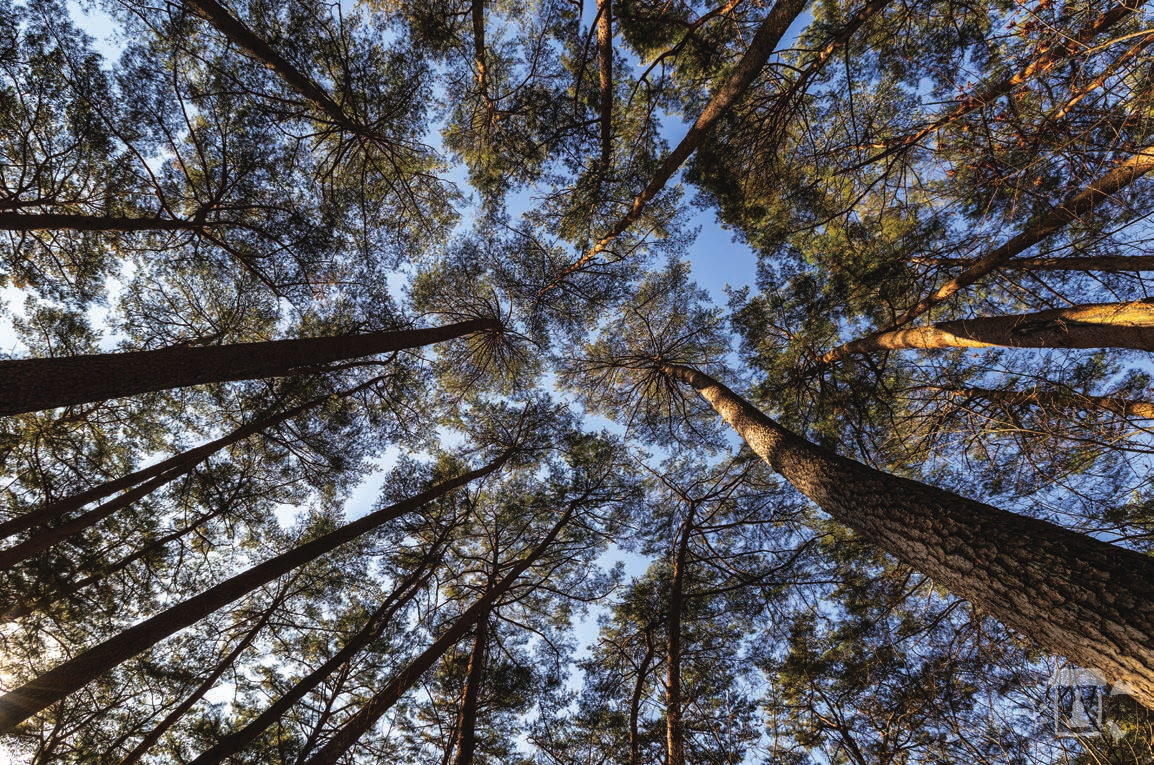
A visit to Beopheungsa Temple would be incomplete without visiting the pine forest, not to mention the Buddha Relic Sanctuary. The dense pine forest leading to Beopheungsa Temple is one of the "100 Best Forests in Korea," as selected by the Korea Forest Service. During the Joseon Dynasty, the pine trees here were so precious that a sign prohibiting logging—reading "Hwangjang-geumpyo"—was erected to protect the pine trees for royal use only. The breathtaking scenery, befitting a hermit sage, created by the valleys and pine trees still inspires awe today. From the Beopheungsa parking lot to the Buddha Relic Sanctuary, the experience of walking among the 25-meter-tall pine trees is truly captivating.



4th Fl. Templestay Information Center 56 Ujeongguk-ro, Jongno-gu, Seoul, South Korea (03145)
Tel : 82-2-2031-2000 / Fax : 82-2-732-9928
Copyright ⓒ 2020 Templestay webzine. All Rights Reserved.
4th Fl. Templestay Information Center 56 Ujeongguk-ro, Jongno-gu, Seoul, South Korea (03145)
Tel : 82-2-2031-2000 / Fax : 82-2-732-9928
Copyright ⓒ 2020 Templestay webzine. All Rights Reserved.