


Time to find myself

Sound of Flowing Water
H
>Time to find myself
>Sound of Flowing Water

Memories
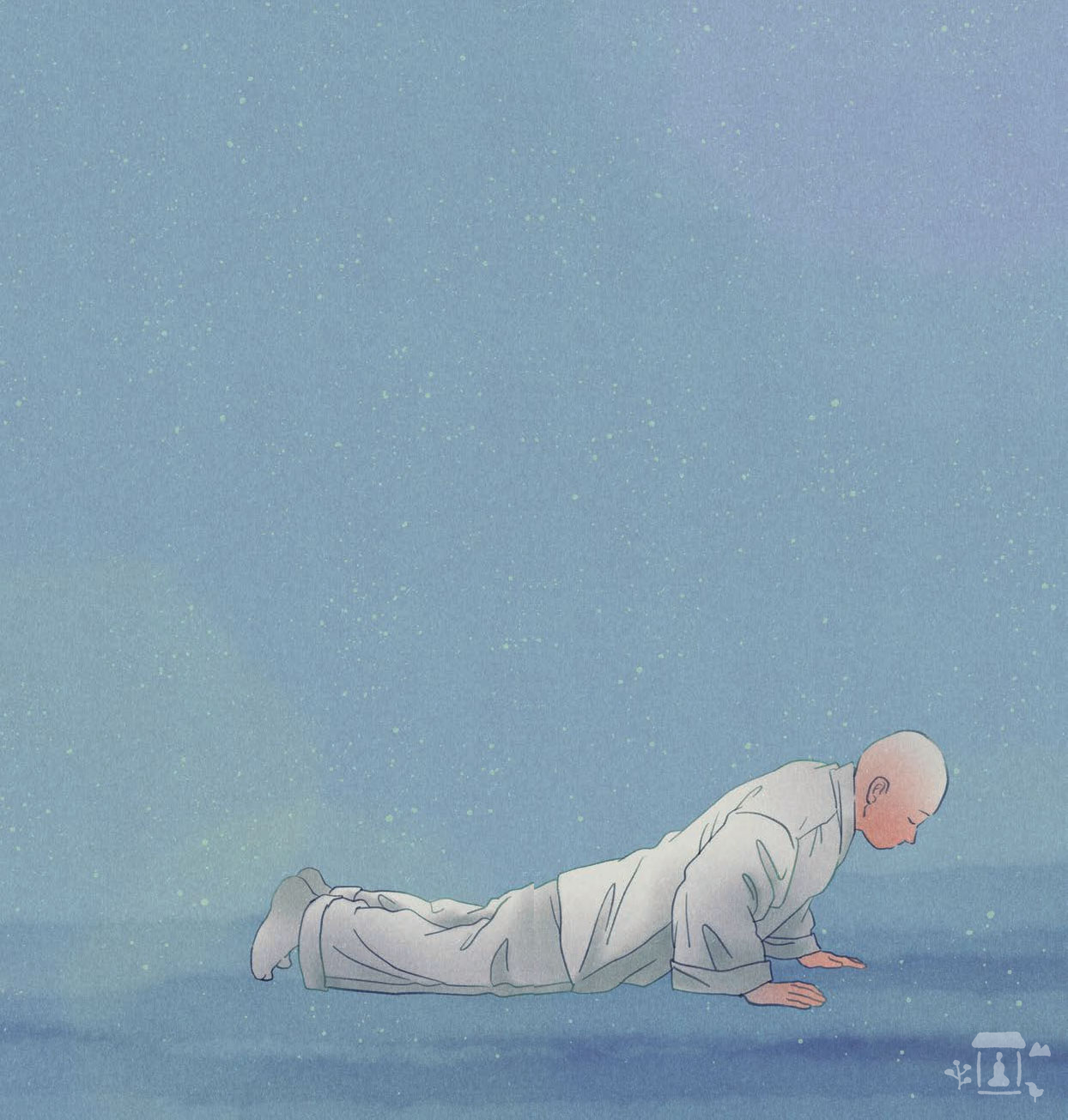
One early morning, I was doing prostrations in an unfamiliar dharma hall at a temple I was visiting for the first time. I'd never been there before, and it was located in a place I'd never heard of. I previously had no idea this temple even existed. And yet, here I was prostrating myself.
The morning before, I'd spent many hours on a rush-hour electric train, all of us passengers packed together like sardines. As I approached my destination, the car became noticeably less crowded. Outside the station, I saw no buildings or apartment complexes, only a stream flowing through a yellow-brown landscape. I caught a waiting taxi. When I told the driver where I was headed, he asked me again. I repeated it and got the same result. Then he asked to look at my phone. He glanced at the address on my map app and then firmly placed my phone next to his steering wheel.
The driver was a Buddhist. He lifted the jet-black suede covering the dashboard, and beneath it, like hidden treasures, were copies of the Diamond Sutra he had transcribed and bound with a golden cover. Several pens, used for copying sutra, were lined up on the sun visor. A "manja" (Buddhist cross) ornament dangled from the rearview mirror. My driver seemed a little elated. I was already quite exhausted from the long train ride, but I wanted to be a good companion to the driver. I had a feeling that where I was going would be impossible to reach without him and without his kindness. So, I listened to stories of his childhood, about him carrying rice offerings to temples on his head while walking barefoot in winter, about his battle with lung cancer and his miraculous recovery, and about his current religious life. These stories continued to unfold as we wound our way through the valleys. And yet, our destination still seemed far away. The sky outside grew bluer, and the road was getting narrower and narrower. The shadows cast by the chestnut trees, shrouded in thick condensation, made it even more difficult to discern where the road was. I was glad the driver was a Buddhist. I was also glad that he was a good storyteller, someone who never seemed to shy away from or get bored with the long drive through this rough and unfamiliar terrain, where driving fast was dangerous. The slope gradually steepened until, finally, a temple came into view. We had reached the end of the road: Nordkapp, the northernmost point of Norway and the European continent, some 600 kilometers from Tromsø.
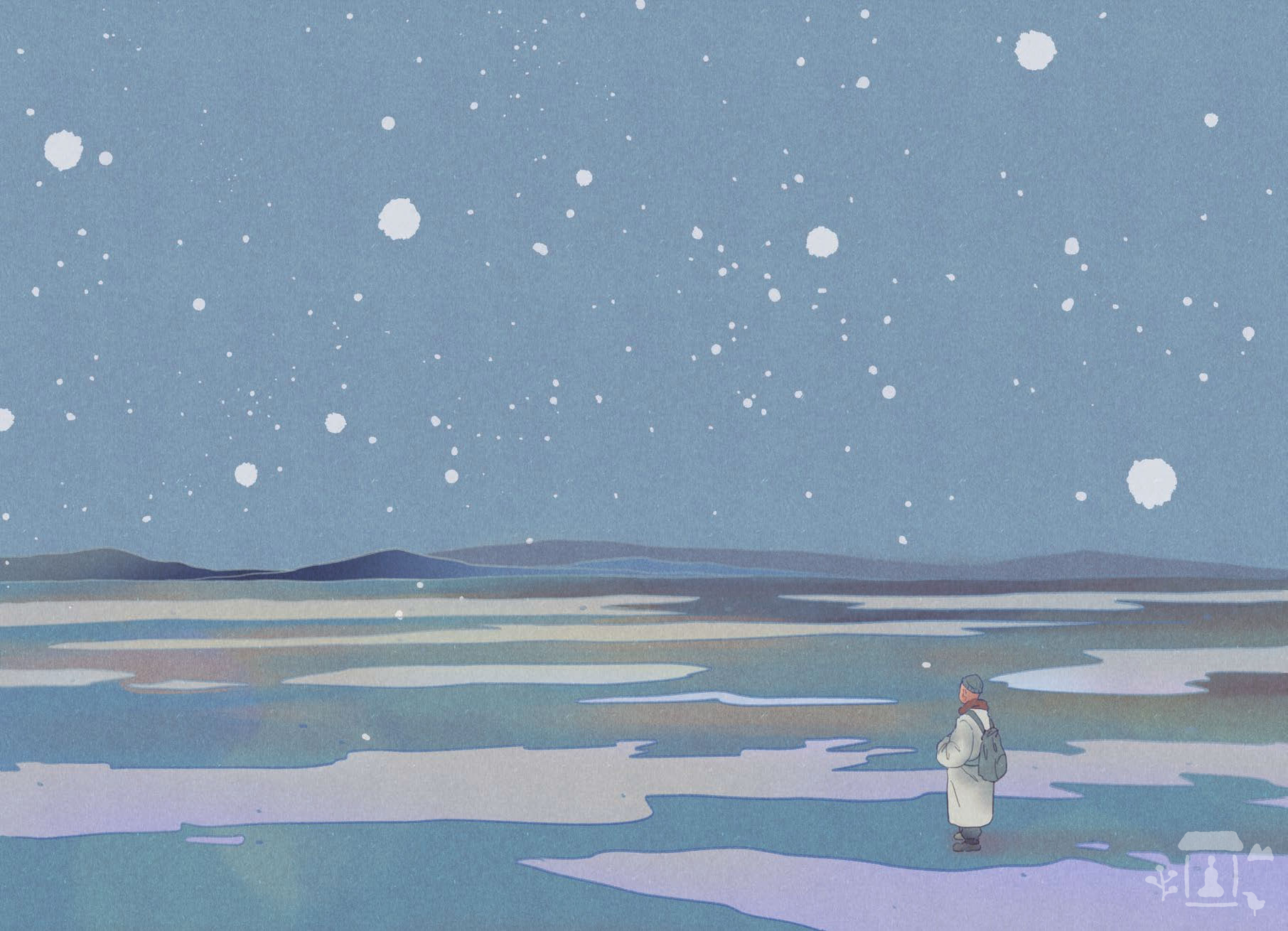
Norwegian forests at the beginning of autumn are as mystical as the singing of fairies, and the rainbows, unfolding everywhere like a fairy's musical score, were also enchanting. However, at some point, all around us became a wasteland. Outside were only a hazy sky and the silence of the stones. Our chatter drifted through the car, trying to ease the rising sense of tension from an unknown source, but it was pointless. Even the cheerful music seemed out of place.
On our first day, we returned drenched in rain. I found lodging in a town about 40 minutes away by car. The weather was fine on our second day. Even though it was off-season for traveling to this northernmost part of Norway, I saw lots of people. At the parking lot, they checked and recorded our nationality. Atop the cliff, I saw a cafe, souvenir shop, small theater, and a museum with a chapel.
But the wind was the lord and master of this place. It obliterated everything at a rapid pace. The countless elements that made this place a tourist attraction were all made irrelevant by the powerful, omnipresent wind: the parking lot, the museum, the expensive but cold hot dogs, the ugly keychains, the tourists themselves, and even the behavior and gazes of the tourists.
I stopped at the edge of a cliff. Could it be called a breathtaking view? The sea was simply the sea, and it revealed nothing to me. The softer parts of my body shuddered in the ceaseless wind. A myriad of thoughts blew away in the wind, broken and shattered. I sensed the world gradually becoming flatter. The space, the ground, the distance, the nearness, even life and death were becoming flatter. I was part of the cliff, part of the earth, and part of a clump of grass growing there lying down. I was part of the sheep that had died and decomposed there. I was a part of everything that had been scattered, was being scattered, and will be scattered. How flat was my foundation. Suddenly, even my fears were blown away.
In Norway, I saw forests and rainbows. I saw reindeer and the northern lights. But what I had never seen before, not in photographs or dreams, what I truly saw for the first time, was only one thing: the flatness of the world and the peace that this flatness brought.
Upon arriving at the temple, the driver handed me his business card, telling me to call him if I needed a ride since there was no other transportation available. An old monk approached the taxi, now catching its breath after arriving at the remote temple courtyard. I explained the purpose of my visit, and he gave me directions. I had come to the temple to give a senior monk some snacks and coffee beans I'd brought from town. The last time I saw him was three years ago. He hadn't told me where he was, but I had managed to find his address after some wrangling, determined to send him a small package. I hadn't planned on coming in person. That was a sudden decision I made on my own.
My old friend hadn't changed in the past three years. We ate, drank tea, and took long walks through the garden where the crows gathered. He told me I hadn't changed either, but I had changed a little. But upon meeting him again, wouldn't I be reminded of who I once was? Wouldn't I pause on the spur of the moment? Wouldn't I make a detour? I offered him some cookies and coffee beans, and he handed me a pair of cotton gloves. Then he taught me how to do a proper prostration. I continued prostrating myself behind him as he prayed. And we repeated this ritual that afternoon and the next dawn.
Was I the earth? A clump of grass growing, lying down? Was I the place a flock of sheep had died, and where a flower now grew? Was I a steep cliff at the end of the road? The cliff on which rain poured down and sunlight beamed down upon; the cliff tempered sharp by the fierce wind, by the waves crashing down, only to crumble again. The movement that had lasted a long time with softness and firmness. The pulse. That image lingered a long time, gradually growing flatter.



4th Fl. Templestay Information Center 56 Ujeongguk-ro, Jongno-gu, Seoul, South Korea (03145)
Tel : 82-2-2031-2000 / Fax : 82-2-732-9928
Copyright ⓒ 2020 Templestay webzine. All Rights Reserved.
4th Fl. Templestay Information Center 56 Ujeongguk-ro, Jongno-gu, Seoul, South Korea (03145)
Tel : 82-2-2031-2000 / Fax : 82-2-732-9928
Copyright ⓒ 2020 Templestay webzine. All Rights Reserved.