


Buddhism Culture

Special Feature
H
>Buddhism Culture
>Special Feature
“Temple food, presenting a sustainable future for humanity”
Cultural Corps of Korean Buddhism's Temple Food “Talk Concert”
World-Class Chefs in One Place, including Eric Ripert
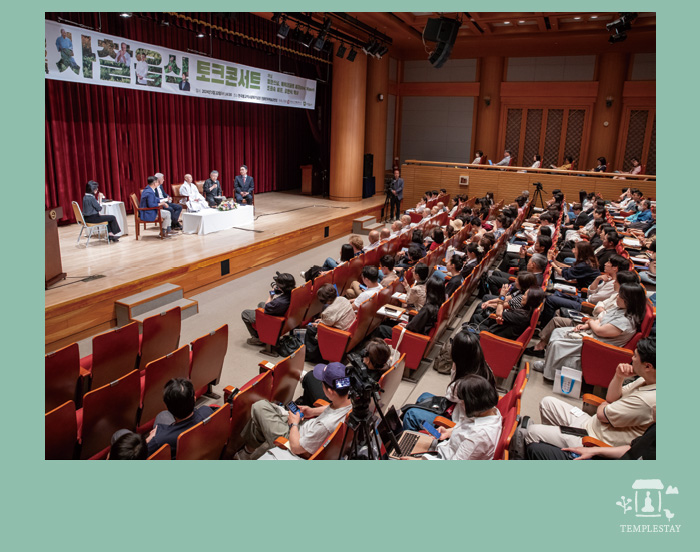
Ven. Jeong Kwan: “The link between food, nature and humanity”
Chef Cho Hee-sook: “Attention to the meaning of the Five Contemplations”
Professor Gong Man-sik: “Need to expand an ethical perspective”
“Temple food offers food for the future that humanity should enjoy.”
World-renowned chefs are paying attention to the value and potential of temple food. This was evidenced at a series of lectures sponsored by the Cultural Corps of Korean Buddhism on May 22nd under the theme “Humanity, the Climate Crisis, and Temple Food.” The lectures on this day were planned to coincide with the visit of Eric Ripert, co-owner of Le Bernadin, a Michelin 3-star restaurant in New York. It also featured Eastern and Western experts in the culinary field as panelists, including Ven. Jeong Kwan, a temple food master, chef Cho Hee-sook of Hansikgonggan, and Professor Gong Man-sik of Dongbang Culture University.
On this day, Eric Ripert highly praised temple food, saying, “Temple food shows the future of food for us to enjoy in that it considers the environment, food ingredients, sustainability, and even the health and karma of those who eat the food.” His explanation is that temple food not only uses natural ingredients, excluding processed meats, but also considers the cooking process as part of spiritual practice. Therefore, it is inevitable that it will have a beneficial effect on the mind of the person eating it and the global environment as well. In particular, he focused on the fact that food is recognized as medicine at temples, saying, “It is a culture that fundamentally has a completely different approach from the Western perspective on food, and has a profound meaning that transcends being simply food.”
Chef Cho Hee-sook agreed, saying, “Temple food shows us that food does more than just sustain life. It is medicine that assists the body and mind by supplying mental energy,” emphasizing the importance of promoting the Buddhist spirit inherent in temple food.
Chef Cho continued, saying, “With more than 70% of the land area being mountainous and three sides surrounded by sea, Korea has the advantage of being rich in food ingredients. Thus, Koreans have developed ways to preserve perishable vegetables, and there are various ways to use Korean fermented sauces (jang) to add flavor, developing a culture that is very advantageous for a veggie-centered diet.” She also emphasized, “If we develop our own diet based on rice and vegetable side dishes, it has the potential to become an alternative future food.” Chef Cho is considered one of the best female chefs in Asia, and on this day, she received a positive response by reciting the Five Contemplations—a Buddhist pre-meal prayer—that she reinterpreted from the perspective of making food.
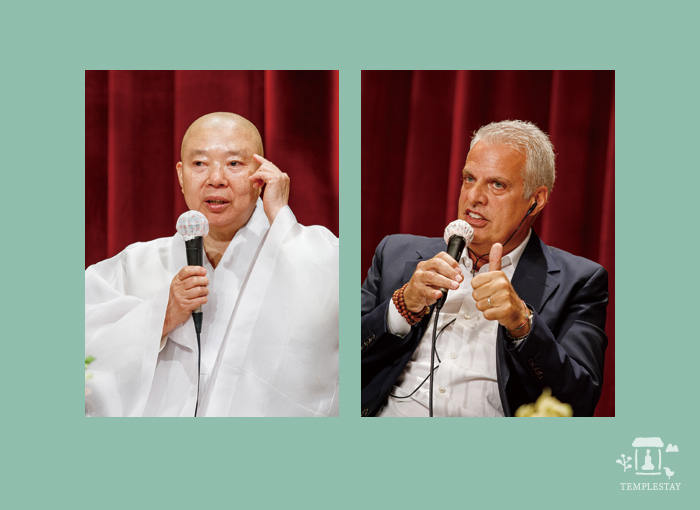 Ven. Jeong Kwan, Eric Ripert
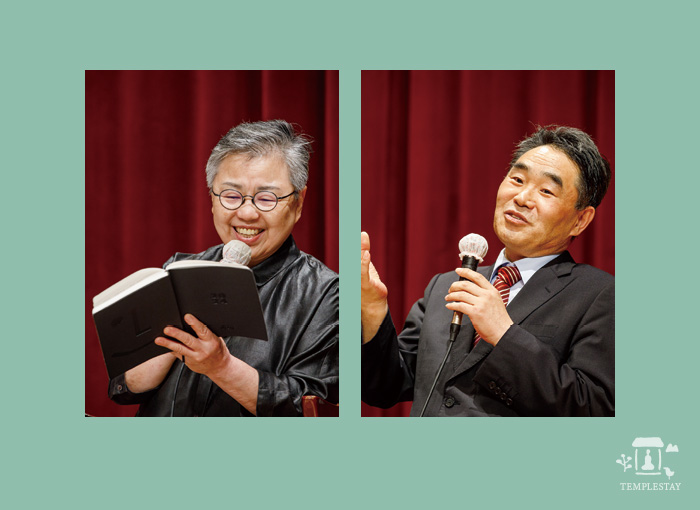 Chef Cho Hee-sook, Professor Gong Man-sik
Ven. Jeong Kwan, a temple food master, said, “Temple food is about symbolically eating with gratitude the emotions exchanged between you and me, and between nature and me. If we think about and understand the origin of such food, it can play a bigger role as a sustainable alternative for humanity.”
She also expressed the view that baru gongyang (formal monastic meal) can be a partial solution to the climate crisis. Because baru gongyang is a way of showing respect for all living things, one can help protect nature by eating only enough to sustain oneself, rinsing the bowl with water after eating, and drinking the rinse water.
Ven. Jeong Kwan continued, saying, “Food is a medium that connects mental energy and physical energy, and since the source of food is nature, eating food is also an act of connecting nature and people.”
Professor Gong Man-sik—considered a pioneer in Buddhist food studies—also pays attention to the relationships enabled by temple food, especially the relationship between humans and nature and the various relationships between humans themselves are affected by the food we eat.
Professor Gong says, “Modern studies in food and nutrition ignore these relationships inherent in food and only look at food, whereas Buddhism views relationships as a key aspect of food and applies an ethical perspective. In other words, wholesomeness and unwholesomeness influence one's criteria for deciding what food to eat. From this perspective, academic research on temple food needs to be further expanded.”
Meanwhile, during his visit to Korea from May 19 to 22, Eric Ripert completed a variety of activities to intensively explore temple food that reflects Korean Buddhist culture and philosophy. Accompanied by food critic and writer Joshua David Stein, there was a conversation over tea with Ven. Jinwoo (president of the Jogye Order), a meeting with Ven. Gyeho from Jinkwansa Temple (a temple food master), a collaboration with Ven. Jeong Kwan from Cheonjinam Hermitage for a temple food dinner, and a Templestay at Baekyangsa Temple. The lectures on this day were the last official activities during Eric Ripert's visit to Korea.
At a meeting with Ven. Mugong, the abbot of Baekyangsa Temple, Eric Ripert said, “In the past, I operated and promoted restaurants with the aim of flattering my ego, but when I met Ven. Jeong Kwan, my thinking changed. Since then, I have tried to cook with the pure intention of making people happy, and I have taught that to my students as well.”
In response, Ven. Mugong said, “Cooking with the mindset of making people happy is itself the path of a bodhisattva. You are a keen-eyed practitioner because you practice pure giving with no expectation of return, which reflects the virtue of sharing and the spirit of self-help and altruism.”
Sweden, Fascinated by the Beauty of
Korean Traditional Buddhist Culture
Successful “Korean Traditional Buddhist Culture Photo Exhibition” in May by the Cultural Corps of Korean Buddhism & the Korean Cultural Center in Sweden
Exhibition of 50 Works on 3 Themes Including “Practitioners on the Road”
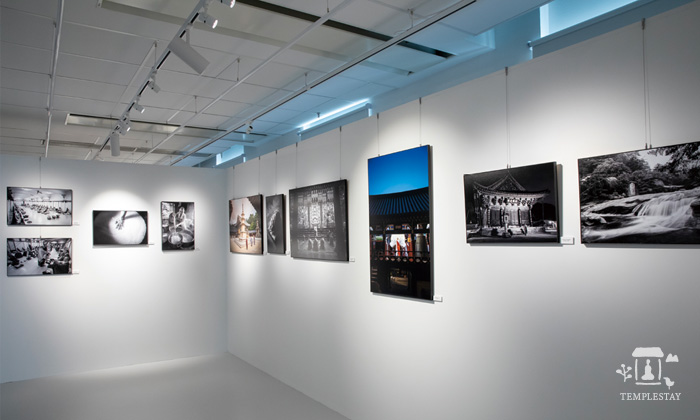
The Cultural Corps of Korean Buddhism (headed by Ven. Mandang; hereafter “the Corps”) held the “Korean Traditional Buddhist Culture Photo Exhibition” on the first-floor lobby of the Korean Cultural Center in Sweden during the month of May.
The photo exhibition was prepared as part of a ceremony to commemorate the first anniversary of the opening of the Korean Cultural Center in Sweden.
This photo exhibition is noteworthy because it is the first event held in Sweden solely on the theme of Korean traditional Buddhist culture. The 50 photos displayed in the lobby on the first floor depict aspects of Korean Buddhist culture and are organized into three major themes: “Practitioners on the Road,” “Templestay,” and “Temple Food.”
As the photo exhibition was planned at the request of the Korean Cultural Center in Sweden, it is considered an exemplary case of how to expand the Corps' promotion efforts in collaboration with overseas institutions.
In celebration of its first anniversary, the Korean Cultural Center in Sweden has been considering ways to more effectively promote the allure of K-culture in Sweden. Accordingly, they reviewed photos provided by the Corps, which captured various aspects of traditional Korean Buddhist culture, and requested cooperation from the Corps, saying the Center would secure a venue and provide most of the budget for the photo exhibition. The photos provided by the Corps were taken by photographer Ha Ji-kwon (from 2021 to the present) as part of a project to record various aspects of Korean traditional and Buddhist culture.
At the opening ceremony of the exhibition on May 7, photographer Ha Ji-kwon said, “I have been traveling to many temples with my camera and meeting many practitioners for over 23 years. I have captured practitioners I met on the road and various aspects of Korean Buddhism in the camera frame. I am happy to present these photos to commemorate the first anniversary of the Korean Cultural Center in Sweden.
I hope this will help the Swedish people come to know and better understand Korea’s traditional Buddhist culture.”
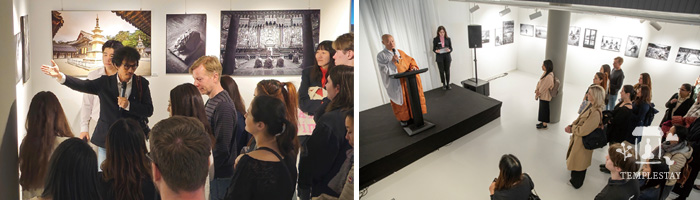

The first theme of this photo exhibition, “Practitioners on the Road,” consisted of works that captured images of practitioners silently walking the path to find their true self and practicing the lineage of cultivation passed down over 1,700 years of Korean Buddhist history, beginning with photos of the daily temple ground chanting at dawn. The second theme, “Templestay,” featured participants of various nationalities experiencing Templestay programs and the beautiful scenery of Korean mountain temples. The 3rd theme, “Temple Food,” featured works that depict baru gongyang (formal monastic meal), a centuries-old tradition, and traditional temple kitchens, as well as Ven. Jeong Kwan, a temple food master well known to people around the world through a Netflix series.
In greeting remarks read by Ven. Secretary-General Daewoo, Ven. Director Mandang of the Corps said, “The Korean temples you will see in this photo exhibition are historic temples that have existed for the past thousand years.
They are dynamic spaces that still pulsate with life today. I expect that the beauty of these temples that coexist in harmony with nature, the monks and nuns who practice there to preserve 1,700 years of Buddhist tradition, and the various aspects of the Templestay programs where ordinary people spend a day or two at a temple will be somewhat unfamiliar to you but deeply moving at the same time.”
Ven. Mandang continued, saying, “I am glad that the Cultural Corps of Korean Buddhism can undertake this journey of opening wider the channels of cultural communication between our two countries. I hope this exhibition will serve as an opportunity for Koreans and Swedes to grow closer in spirit.”
In his congratulatory speech, Korea's ambassador to Sweden, Lee Hyung-jong said, “Through this photo exhibition, I hope that our friends here in Sweden will be able to get a glimpse of the beauty of Korean Buddhist culture. This exhibition has a special meaning as it also commemorates Buddha's Birthday in addition to the first anniversary of the Korean Cultural Center in Sweden. I would like to thank all the people involved, including the Cultural Corps of Korean Buddhism and photographer Ha Ji-kwon, who made this photo exhibition possible.”
The exhibition, which lasted throughout the month of May, concluded successfully on the 28th. In particular, interest was focused on the fact that it was possible to be introduced to the unfamiliar cultures of other countries through photography. And the photos under the theme “Practitioners on the Road,” which captured various aspects of monastic life, received overwhelming attention. As the photo exhibition continued, reflecting high local interest, visitors asked many questions about daily life in Korean temples and the lives of monks.
Meanwhile, after the exhibition in Sweden, the Corps is preparing a photo exhibition to promote traditional Buddhist culture at the Korean Cultural Center in Osaka, Japan, possibly this coming October.



4th Fl. Templestay Information Center 56 Ujeongguk-ro, Jongno-gu, Seoul, South Korea (03145)
Tel : 82-2-2031-2000 / Fax : 82-2-732-9928
Copyright ⓒ 2020 Templestay webzine. All Rights Reserved.
4th Fl. Templestay Information Center 56 Ujeongguk-ro, Jongno-gu, Seoul, South Korea (03145)
Tel : 82-2-2031-2000 / Fax : 82-2-732-9928
Copyright ⓒ 2020 Templestay webzine. All Rights Reserved.